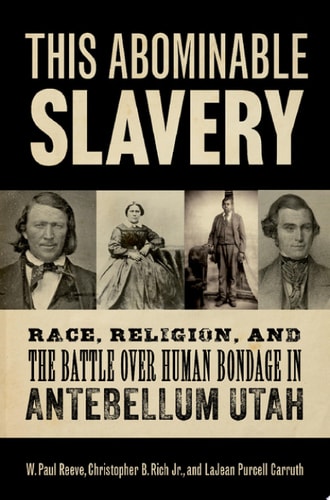
This Abominable Slavery: Race, Religion, and the Battle over Human Bondage in Antebellum Utah
0
0
As an Amazon Associate and affiliate partner, Menrva Books earns from qualifying purchases. Learn more
Author Description
On July 22, 1847, a group of about forty refugees entered the Salt Lake Valley. Among them were three enslaved men, two of whom shared the religion, Mormonism, that had caused them to flee. The valley was also home to members of the Ute tribe, who would sometimes barter captive women and children to Spanish colonizers. Thus, the question of whether the Latter-day Saints would accept or reject slavery in their new Zion confronted them on the day they first arrived. Five years later, after Utah had become an American territory, its legislature was prodded to take up the question then roiling the nation: would they be slave or free?George D. Watt, the official reporter for the 1852 legislative session, reported debates and speeches in Pitman shorthand. They remained in their original format, virtually untouched, for more than one hundred and fifty years, until LaJean Purcell Carruth transcribed them. In this eye-opening volume, Carruth, Christopher Rich, and W. Paul Reeve draw extensively on these new sources to chronicle the session, during which the legislature passed two important statutes: one that legally transformed African American slaves into "servants" but did not pass the condition of servitude on to their children and another that authorized twenty-year indentures for enslaved Native Americans.This Abominable Slavery places these debates within the context of the nation's growing sectional divide and contextualizes the meaning of these laws in the lives of Black enslaved people and Native American indentured servants. In doing so, it sheds new light on race, religion, slavery, and unfree labor in the antebellum period.
Menrva's Summary
THE THESIS
This work investigates the complex intersection of Mormon theology, territorial governance, and the institution of human bondage in antebellum Utah. The authors, including historian W. Paul Reeve and transcriber LaJean Purcell Carruth, utilize newly recovered Pitman shorthand transcripts from the 1852 legislative session to analyze how the Latter-day Saints navigated the national debate over slavery. By examining the specific statutes passed regarding African American and Native American servitude, the authors argue that these legislative decisions were deeply influenced by both religious doctrine and the pressures of the American sectional divide.
THE SCOPE MAP
What You Will Find
- Primary source transcripts from the 1852 Utah legislative session originally recorded in Pitman shorthand.
- An analysis of the legal transition of enslaved African Americans into a specific category of servitude.
- Examination of the legislative authorization of twenty-year indentures for Native Americans.
- Contextualization of Utah's unique labor laws within the broader national crisis of the antebellum period.
THE AUTHORITY PERSPECTIVE
Experts highlight this volume as a significant contribution to the study of Western American history due to the inclusion of previously inaccessible primary source material. Readers frequently note the academic rigor of the analysis and the clarity with which the authors connect local legislative actions to national political trends.
Page Count:
312
Publication Date:
2024-10-18
Publisher:
Oxford University Press
ISBN-10:
0197765025
ISBN-13:
9780197765029
History
Religion
American History
Utah history
Americas
Slavery
Race Relations
Community Tags
Similar Books