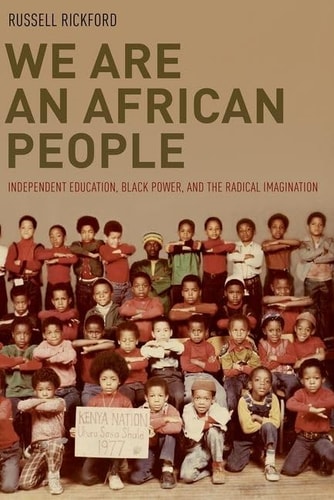
We Are an African People: Independent Education, Black Power, and the Radical Imagination
0
0
As an Amazon Associate and affiliate partner, Menrva Books earns from qualifying purchases. Learn more
Author Description
During the height of the Black Power movement of the late 1960s and 1970s, dozens of Pan African nationalist private schools, from preschools to post-secondary ventures, appeared in urban settings across the United States. The small, independent enterprises were often accused of teaching hate and were routinely harassed by authorities. Yet these institutions served as critical mechanisms for transmitting black consciousness. Founded by activist-intellectuals and other radicalized veterans of the civil rights movement, the schools strove not simply to bolster the academic skills and self-esteem of inner-city African-American youth but also to decolonize minds and foster a vigorous and regenerative sense of African identity.In We Are An African People, historian Russell Rickford traces the intellectual lives of these autonomous black institutions, established dedicated to pursuing the self-determination that the integrationist civil rights movement had failed to provide. Influenced by Third World theorists and anticolonial campaigns, organizers of the schools saw formal education as a means of creating a vanguard of young activists devoted to the struggle for black political sovereignty throughout the world. Most of the institutions were short-lived, and they offered only modest numbers of children a genuine alternative to substandard, inner-city public schools. Yet their stories reveal much about Pan Africanism as a social and intellectual movement and as a key part of an indigenous black nationalism.Rickford uses this largely forgotten movement to explore a particularly fertile period of political, cultural, and social revitalization that strove to revolutionize African American life and envision an alternate society. Reframing the post-civil rights era as a period of innovative organizing, he depicts the prelude to the modern Afrocentric movement and contributes to the ongoing conversation about urban educational reform, race, and identity.
Menrva's Summary
THE THESIS
This work investigates how independent Pan African nationalist schools in the United States during the 1960s and 1970s functioned as sites of political radicalization and cultural identity formation. Historian Russell Rickford examines the intellectual foundations of these autonomous institutions, which were established by civil rights veterans seeking to move beyond integrationist models. By analyzing the influence of Third World anticolonial movements, the author argues that these schools were not merely educational alternatives but deliberate attempts to cultivate a vanguard of activists committed to global black political sovereignty.
THE SCOPE MAP
What You Will Find
- Historical analysis of Pan African nationalist private schools in urban American settings.
- Examination of the intellectual lineage connecting the Black Power movement to anticolonial theory.
- Documentation of the pedagogical goals aimed at decolonizing the minds of African American youth.
- Contextualization of the movement within the broader post-civil rights era of social and political innovation.
Scope Limits
- The study focuses primarily on the intellectual and political history of these institutions rather than providing a comprehensive quantitative analysis of student outcomes.
- The narrative is limited to the specific period of the late 1960s and 1970s, excluding long-term longitudinal studies of the schools' graduates.
THE AUTHORITY PERSPECTIVE
Scholars and historians recognize this text as a significant contribution to the study of black nationalism and the history of alternative education in the United States. Readers frequently note the depth of the archival research and the author's ability to frame these localized educational experiments within a broader global political context.
Page Count:
402
Publication Date:
2019-01-01
Publisher:
Oxford University Press
ISBN-10:
0190055537
ISBN-13:
9780190055530
History
Politics
Education
Education Theory
Professional Career & Trade
United States
African American
Americas
Race Relations
African Americans
Education Teaching
Schools & Teaching
Special Topics
American History
Educational Resources
Student Life
Sociology
Black power
Educational Foundations
Community Tags
Similar Books