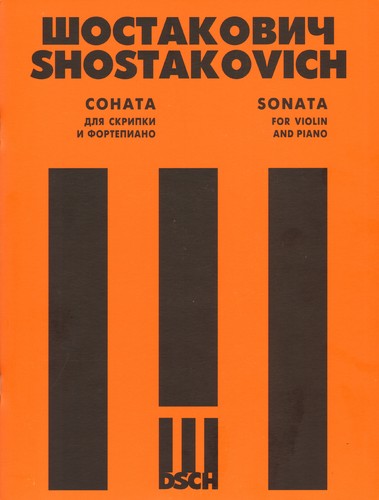
Sonata for Violin and Piano, Op. 134
0
0
As an Amazon Associate and affiliate partner, Menrva Books earns from qualifying purchases. Learn more
Author Description
Shostakovich's Violin Sonata is one of the very finest productions of his late career, a chamber work of unbending grandeur and seriousness and on a huge and muscular scale. Written in the autumn of 1968 for the occasion of the 60th birthday of the composer's friend the great violin virtuoso David Oistrakh, and in the wake of the Second Violin Concerto he had written for the same artist in the previous year, the sonata embodies Shostakovich's love for Oistrakh's phenomenal artistry, for the sweetness and tragic intensity of Oistrakh's singing tone and for his tremendous abilities to make the music pound and throb with dance-rhythms. At the time when he composed this sonata, the composer was becoming fascinated with the idea of the 12-note row. Although he was never a serial composer, he was lured by the harmonic and motivic discipline that 12-note music suggested and this sonata abounds in 12-note ideas which give the music a dark, sinewy and ascetic feel. The other great influence on this music is Bach. So the substantial first movement continually suggests the world of Bach's great fugues from the '48' and the St Matthew Passion. It also rings with the strange chiming of funeral bells. The second and central movement, by contrast, takes us into a quite different enthusiasm of Shostakovich's: 'klezmer' or Jewish wedding music. This allegretto suggests a terrifying dance in which aggression and intense sympathy are held in a dangerously unstable balance until the movement hammers towards a tragic climax. The long finale, a mighty set of variations in the form of a passacaglia, again returns us to the world of Bach, with much fugal part-writing, echoes of the haunting cadences of chorales and clear hints that Shostakovich had in mind as a model the most famous of all Bach's works for violin, the mighty Chaconne from his 3rd solo Partita. In the very closing bars Shostakovich brings us back once more to the funeral bells from the first movement. - Gerard McBurney at b
Menrva's Summary
THE THESIS
The Violin Sonata, Op. 134, stands as a monumental chamber work from Dmitri Shostakovich's late period, characterized by its profound seriousness and expansive scale. Composed in 1968 as a tribute to violinist David Oistrakh, the sonata reflects Shostakovich's deep admiration for Oistrakh's virtuosity and expressive tone. While not a serial composer, Shostakovich incorporated 12-note ideas, lending the work a dark, sinewy quality, and drew significant inspiration from the music of J.S. Bach, particularly his fugues and chorales. The composition explores a range of moods, from the Bach-ian grandeur of the first movement, tinged with the sound of funeral bells, to the intense, unsettling energy of the central movement's Jewish wedding music, and finally returning to Bach-inspired variations in the finale.
THE SCOPE MAP
- The first movement, substantial in scope, evokes the intricate counterpoint of Bach's fugues and chorales, interspersed with the somber resonance of funeral bells.
- The central Allegretto movement shifts dramatically, drawing on 'klezmer' or Jewish wedding music to create a terrifying dance of conflicting emotions.
- The finale is structured as a lengthy passacaglia, presenting a mighty set of variations that again reference Bach, particularly his Chaconne for solo violin.
- The work features extensive fugal writing, a hallmark of Bach's influence on Shostakovich's compositional technique.
- The sonata's harmonic language incorporates 12-note ideas, contributing to its ascetic and disciplined feel.
- The composition is dedicated to the renowned violinist David Oistrakh, celebrating his artistry.
- The piece concludes by echoing the funeral bell motif introduced in the opening movement, providing a sense of cyclical closure.
THE AUTHORITY PERSPECTIVE
Shostakovich's Violin Sonata, Op. 134, is widely regarded as one of the finest chamber works of his late career, praised for its unbending grandeur and thematic depth. Musicologists and performers frequently highlight its sophisticated engagement with Bach's contrapuntal techniques and its innovative use of 12-note ideas within Shostakovich's distinctive harmonic language. The work's emotional range, from profound solemnity to unsettling intensity, is often cited as a testament to the composer's mastery. Its dedication to David Oistrakh underscores its significance as a personal and artistic statement, celebrating a profound musical partnership.
Page Count:
0
Publication Date:
2017-01-01
ISBN-13:
9790706427218
Music
Piano
Chamber Music
Violin
Music Scores
Composition
Community Tags
Similar Books