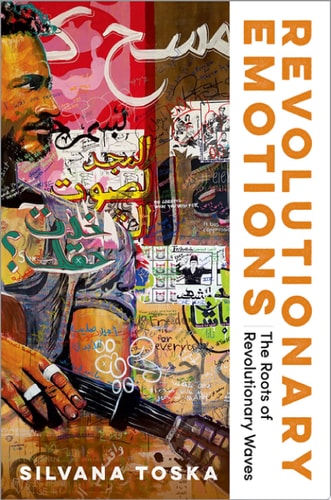
Revolutionary Emotions: The Roots of Revolutionary Waves
0
0
As an Amazon Associate and affiliate partner, Menrva Books earns from qualifying purchases. Learn more
Author Description
Revolutionary Emotions proposes a novel emotional theory of revolutionary diffusion and success and argues that emotional mobilization is at the root of both. For centuries, revolutionaries spoke of the emotional arousal--the anger, hope, and the jettisoning of fear--that motivated their participation in revolt. Studies of revolutions, however, rarely give these emotional narratives the power that actors themselves recount. This book argues that revolutionary waves, including the 1848 revolts and the Arab Uprisings, cannot be explained without the emotional arousal that motivated potential revolutionaries to imitate neighboring revolts. The shared identity of revolutionaries across borders leads to a shared emotional arousal and adoption of protest frames and methods. Absent this shared identity, revolutions are unlikely to cause sufficient emotional resonance to spur imitators across borders. In addition to a shared identity, previous history of protests makes diffusion more likely, as seasoned activists capitalize on this emotional jolt to mobilize against their regimes. The emotional power of the crowds is tangible--if difficult to measure--and influences the decisions of key elite players, including the military, on whether to allow the regime to fall.By grounding the theory in the emotional narratives of revolutionaries and by breaking down the various dichotomies that plague the study of revolutions--structure versus agency, and domestic versus international--Revolutionary Emotions provides the first coherent theory of revolutionary diffusion and success.
Menrva's Summary
THE THESIS
This book investigates the core question of how emotional mobilization serves as the primary driver for the diffusion and success of revolutionary waves across international borders. Silvana Toska, a scholar of political science and international relations, challenges traditional structuralist accounts of revolution by centering the lived emotional experiences of participants. By synthesizing historical narratives with political theory, she argues that shared identity and emotional resonance are necessary conditions for the imitation of protest methods and the eventual collapse of regimes.
THE SCOPE MAP
What You Will Find
- A theoretical framework linking emotional arousal to the diffusion of revolutionary waves.
- Comparative analysis of historical events, including the 1848 revolts and the Arab Uprisings.
- Examination of the role of seasoned activists and their ability to capitalize on emotional jolts.
- Assessment of how crowd emotions influence the decision-making processes of military and political elites.
THE AUTHORITY PERSPECTIVE
Experts recognize this work as a significant contribution to the study of social movements for its attempt to bridge the gap between structural analysis and individual agency. Readers frequently note the academic density of the prose, which provides a rigorous, theory-driven approach to understanding the mechanics of political upheaval.
Page Count:
328
Publication Date:
2024-10-25
Publisher:
Oxford University Press
ISBN-10:
0197774865
ISBN-13:
9780197774861
History
Politics
Sociology
World politics
International relations
Community Tags
Similar Books