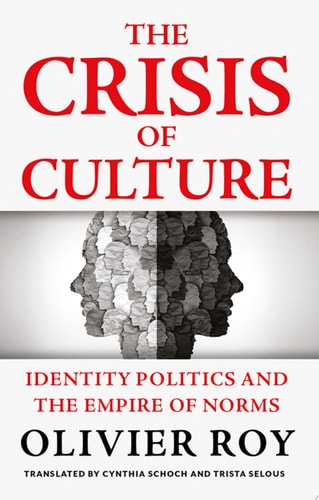
The Crisis of Culture: Identity Politics and the Empire of Norms
0
0
As an Amazon Associate and affiliate partner, Menrva Books earns from qualifying purchases. Learn more
Author Description
Are we confronting a new culture--global, online, individualistic? Or is our existing concept of culture in crisis, as explicit, normative systems replace implicit, social values?Olivier Roy's new book explains today's fractures via the extension of individual political and sexual freedoms from the 1960s. For Roy, twentieth-century youth culture disconnected traditional political protest from class, region or ethnicity, fashioning an identity premised on repudiation rather than inheritance of shared history or values. Having spread across generations under neoliberalism and the internet, youth culture is now individualized, ersatz.Without a shared culture, everything becomes an explicit code of how to speak and act, often online. Identities are now defined by socially fragmenting personal traits, creating affinity-based sub-cultures seeking safe spaces: universities for the left, gated communities and hard borders for the right.Increased left- and right-wing references to "identity" fail to confront this deeper crisis of culture and community. Our only option, Roy argues, is to restore social bonds at the grassroots or citizenship level.
Menrva's Summary
THE THESIS
This book investigates whether the modern concept of culture is in a state of terminal crisis as traditional social values are supplanted by explicit, normative codes. Olivier Roy, a prominent scholar of political Islam and secularism, utilizes a historical and sociological framework to analyze the evolution of identity politics since the 1960s. He argues that the decoupling of political protest from class and community, combined with the rise of neoliberalism and digital individualism, has resulted in a fragmented society defined by affinity-based subcultures rather than shared civic bonds.
THE SCOPE MAP
What You Will Find
- Historical analysis of the 1960s youth culture movement and its long-term impact on political discourse.
- Examination of how neoliberalism and internet culture have accelerated the individualization of identity.
- Critique of contemporary left-wing and right-wing reliance on identity politics as a substitute for genuine community.
- Theoretical framework for restoring social cohesion through grassroots citizenship and local engagement.
THE AUTHORITY PERSPECTIVE
Experts recognize this work as a rigorous sociological critique of contemporary Western political polarization. Readers frequently note the density of the prose and the author's challenging perspective on the decline of traditional social structures.
Page Count:
232
Publication Date:
2024-01-01
Publisher:
Oxford University Press
ISBN-10:
0197782515
ISBN-13:
9780197782514
Philosophy
Politics
Sociology
Identity politics