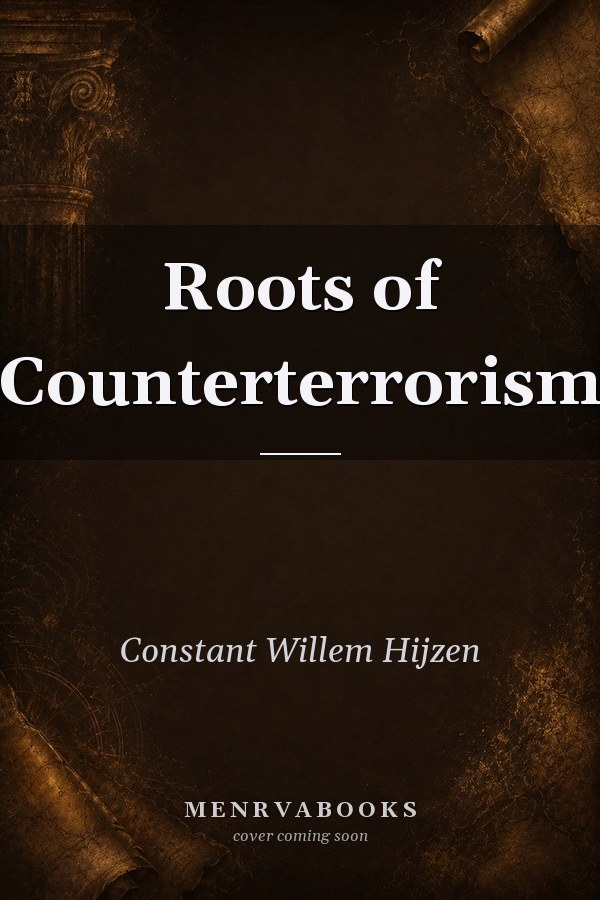
Roots of Counterterrorism
0
0
As an Amazon Associate and affiliate partner, Menrva Books earns from qualifying purchases. Learn more
Author Description
On 22 March 1979, at 09:00 in the morning, the British Ambassador to the Netherlands Sir Richard Sykes and his butler Karel Straub were killed in front of the ambassador's residence, called the Spaansche Hof (Spanish Court). Immediately after the lethal shots were fired, the police unit of The Hague, assisted by police units specialised in counterterrorism and the Dutch security service BVD (Binnenlandse Veiligheidsdienst), commenced their investigation. In an overview of terrorist events in March/April 1979, a special terrorism unit of the Dutch police reported the following details about the events.
Menrva's Summary
THE THESIS
This book investigates the historical origins and institutional development of counterterrorism strategies within the Netherlands during the late 1970s. Constant Willem Hijzen, a scholar specializing in intelligence and security history, utilizes primary source documentation from the Dutch police and the Binnenlandse Veiligheidsdienst (BVD) to reconstruct the state's response to political violence. The work argues that the 1979 assassination of Sir Richard Sykes served as a critical inflection point that forced the professionalization and integration of Dutch counterterrorism units.
THE SCOPE MAP
What You Will Find
- Detailed analysis of the 1979 assassination of British Ambassador Sir Richard Sykes.
- Examination of the operational coordination between the Hague police and the BVD.
- Primary source evidence from internal police reports and security service archives.
- Historical context regarding the evolution of European counterterrorism protocols in the late 20th century.
THE AUTHORITY PERSPECTIVE
Experts in intelligence history highlight this work as a rigorous case study on the institutionalization of security responses to political assassination. Readers frequently note the academic density of the prose and the author's meticulous reliance on declassified archival materials.
Page Count:
0
Publication Date:
2024-01-01
Publisher:
New York, NY : Oxford University Press,
ISBN-10:
0197786057
ISBN-13:
9780197786055
True Crime
History
Terrorism
Prevention
Security Studies
Community Tags
Other Editions(2)
Similar Books