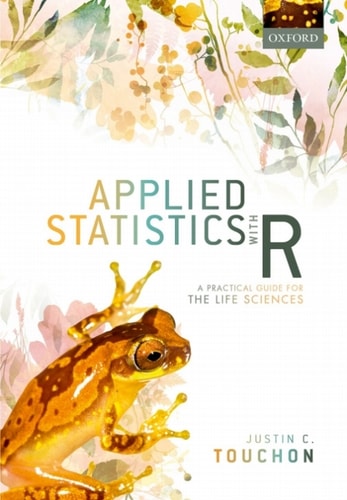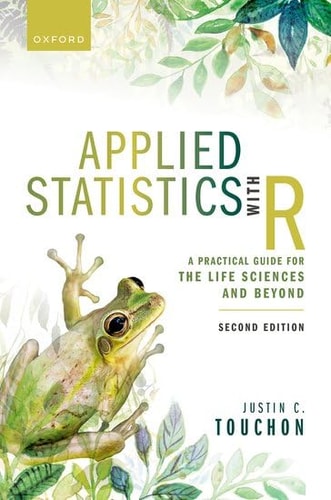
Applied Statistics with R: A Practical Guide for the Life Sciences and Beyond
0
0
As an Amazon Associate and affiliate partner, Menrva Books earns from qualifying purchases. Learn more
Author Description
Over the past few decades, the life sciences have experienced an analytical revolution. With powerful computers now widely available, students and researchers are expected to perform increasingly advanced statistical analyses--previously the domain of only statistical experts. However, most undergraduate and graduate students still lack the proper formal training needed to succeed. Regardless of your experience level, this book will teach you in an efficient, accessible, and occasionally humorous manner, ensuring you understand how and when to perform your analyses.The book uses the statistical language R, which is the choice of ecologists worldwide and is rapidly becoming the 'go-to' stats program throughout the life sciences. By using a single, real-world dataset throughout the book, readers will become deeply familiar with an imperfect but realistic set of data. Early chapters are designed to teach basic data manipulation skills and build good habits in preparation for learning more advanced analyses. This approach demonstrates the importance of viewing data through different lenses, facilitating an easy and natural progression from linear and generalized linear models through to mixed effects versions of those same analyses. Readers will also learn advanced plotting and data-wrangling techniques and gain an introduction to writing their own functions.Applied Statistics with R is suitable for senior undergraduate and graduate students, professional researchers, and practitioners throughout the life sciences, whether in the fields of ecology, evolution, environmental studies, psychology, or neuroscience.
Menrva's Summary
THE THESIS
This book investigates the gap between the increasing demand for advanced statistical proficiency in the life sciences and the lack of formal training available to students and researchers. Justin C. Touchon provides a structured pedagogical framework designed to bridge this divide by utilizing the R programming language. By focusing on a single, real-world dataset, the author guides the reader through the practical application of statistical models, emphasizing the transition from basic data manipulation to complex mixed effects modeling.
THE SCOPE MAP
What You Will Find
- Comprehensive instruction on data manipulation and wrangling techniques within the R environment.
- A progressive framework covering linear, generalized linear, and mixed effects models.
- Practical training on advanced plotting and the development of custom user-defined functions.
- Methodological focus on building reproducible research habits using realistic, imperfect datasets.
THE AUTHORITY PERSPECTIVE
Experts and educators recognize this text as a highly accessible entry point for students and researchers in ecology, psychology, and neuroscience. Readers frequently note that the author's humorous and practical approach effectively demystifies complex statistical concepts for those without a formal background in mathematics.
Page Count:
296
Publication Date:
2025-06-06
Publisher:
Oxford University Press
ISBN-10:
0197797350
ISBN-13:
9780197797358
Science
Statistics
Life sciences
Reference
textbook
Bioinformatics
Applied
Data Science
Community Tags
Similar Books