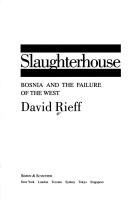
Slaughterhouse
0
0
As an Amazon Associate and affiliate partner, Menrva Books earns from qualifying purchases. Learn more
Author Description
The war in Bosnia has confounded all our expectations. The end of the Cold War, most people imagined in 1989 and 1990, signaled the end of conflict in Europe. What Western Europeans already enjoyed - peace, prosperity, a common market - would be extended to countries like Yugoslavia. Like their neighbors in Croatia and Serbia, Bosnians - Croat, Serb, and Muslim alike - had the same expectations of the post-Communist era. Theirs was already a consumer culture, fueled by ever larger waves of tourists. In 1984, the Winter Olympics were held in Sarajevo. That event seemed to presage the rosiest of futures.. But when the Yugoslavian state began to collapse, Bosnia collapsed with it. Ferocious ethnic and religious antagonisms - held beneath the surface by decades of Communist rule - were seized upon by ex-Communist politicians now turned nationalist, who, desperate to hold on to power, sold them with inceasing propaganda to a nervous population terrified as the civic order they had grown up with fell apart. In 1991, war broke out in Croatia. In April 1992, it came to Bosnia. In reality, it was more slaughter than war. The siege of Sarajevo has gone on longer than any siege in modern history. And, as the world stood by, for the third time in twentieth-century Europe a small minority, this time not the Armenians or the Jews but the Muslims of Bosnia, underwent a genocide. In a shocking and deeply disturbing tour de force, David Rieff - perhaps America's most acclaimed chronicler of displaced people, of lives in flux - journeys into the center of the war in Bosnia, a slaughterhouse made even more horrible by the failure of the West and its surrogate, the United Nations, to do anything to stop the genocide. Rieff follows the civilians, not the fighting. He vividly documents the way the Bosnians moved from their initial shock that this fate of murder and loss was really to be theirs, to their belief that the West, the United States in particular, would help them, to their
Menrva's Summary
THE THESIS
The collapse of Yugoslavia unleashed a brutal conflict in Bosnia, characterized by widespread ethnic cleansing and a prolonged siege of Sarajevo. David Rieff, an acclaimed chronicler of displaced populations, embeds himself with civilians caught in the crossfire of this devastating war. The book details the Bosnians' initial disbelief, their hopes for Western intervention, and the horrifying reality of genocide as the international community largely stood by. Rieff's narrative focuses on the human cost of the conflict, highlighting the failure of Western powers and the United Nations to prevent mass atrocities.
THE SCOPE MAP
- Analysis of the post-Cold War expectations for peace in Europe and their shattering in Yugoslavia.
- Examination of how nationalist politicians exploited ethnic and religious antagonisms following the collapse of Communist rule.
- Detailed account of the Bosnian War, beginning in April 1992, and its characterization as 'slaughter' rather than conventional warfare.
- Focus on the unprecedented length of the siege of Sarajevo and its impact on the civilian population.
- Documentation of the genocide against Bosnian Muslims, framed within the context of earlier 20th-century European atrocities.
- Critique of the international community's inaction, specifically the failure of the West and the United Nations to intervene.
- Rieff's journalistic approach, centering on the experiences of civilians rather than military combatants.
- Exploration of the psychological and emotional journey of Bosnians from shock to a desperate hope for external aid.
THE AUTHORITY PERSPECTIVE
David Rieff's 'Slaughterhouse' is recognized for its unflinching portrayal of the Bosnian War and the international community's failure to act. Critics have noted Rieff's powerful journalistic style, which centers the civilian experience amidst horrific violence. The book is often cited for its critical examination of Western policy and the role of the United Nations during the genocide. Its detailed accounts of suffering and the political failures surrounding the conflict have cemented its place as a significant work on the subject.
Page Count:
240
Publication Date:
1995-01-01
ISBN-10:
0099478315
Politics
History
Non-Fiction
Journalism
War Studies
Community Tags
Similar Books