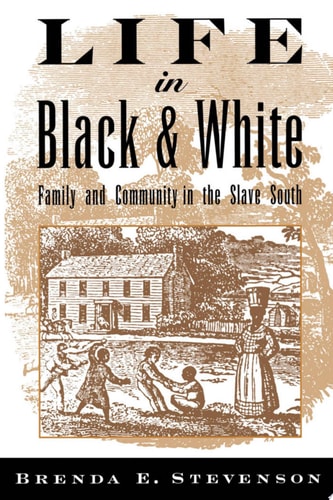
Life in Black and White
0
0
As an Amazon Associate and affiliate partner, Menrva Books earns from qualifying purchases. Learn more
Author Description
Life In The Old South Has Always Fascinated Americans--whether In The Mythical Portrayals Of The Planter Elite From Fiction Such As Gone With The Wind Or In Historical Studies That Look Inside The Slave Cabin. Now Brenda E. Stevenson Presents A Reality Far More Gripping Than Popular Legend, Even As She Challenges The Conventional Wisdom Of Academic Historians. Life In Black And White Provides A Panoramic Portrait Of Family And Community Life In And Around Loudoun County, Virginia--weaving The Fascinating Personal Stories Of Planters And Slaves, Of Free Blacks And Poor-to-middling Whites, Into A Powerful Portrait Of Southern Society From The Mid-eighteenth Century To The Civil War. Loudoun County And Its Vicinity Encapsulated The Full Sweep Of Southern Life. Here The Region's Most Illustrious Families--the Lees, Masons, Carters, Monroes, And Peytons--helped Forge Southern Traditions And Attitudes That Became Characteristic Of The Entire Region While Mingling With Yeoman Farmers Of German, Scotch-irish, And Irish Descent, And Free Black Families Who Lived Alongside Abolitionist Quakers And Thousands Of Slaves. Stevenson Brilliantly Recounts Their Stories As She Builds The Complex Picture Of Their Intertwined Lives, Revealing How Their Combined Histories Guaranteed Loudon's Role In Important State, Regional, And National Events And Controversies. Both The Declaration Of Independence And The U.s. Constitution, For Example, Were Hidden At A Local Plantation During The War Of 1812. James Monroe Wrote His Famous Doctrine At His Loudon Estate. The Area Also Was The Birthplace Of Celebrated Fugitive Slave Daniel Dangerfield, The Home Of John Janney, Chairman Of The Virginia Secession Convention, A Center For Underground Railroad Activities, And The Location Of John Brown's Infamous 1859 Raid At Harpers Ferry. In Exploring The Central Role Of The Family, Brenda Stevenson Offers A Wealth Of Insight: We Look Into The Lives Of Upper Class Women, Who Bore The Oppressive Weight Of
Menrva's Summary
THE THESIS
Brenda E. Stevenson investigates how the social dynamics of family and community life in Loudoun County, Virginia, served as a microcosm for the broader complexities of Southern society from the mid-eighteenth century through the Civil War. Stevenson, a professor of history, utilizes extensive archival research and primary source documentation to challenge traditional historical narratives that often separate the experiences of planters, enslaved individuals, and free Black families. By focusing on the interconnected lives of these diverse groups, she argues that the regional developments in Loudoun County were instrumental in shaping national political and social traditions.
THE SCOPE MAP
What You Will Find
- A detailed examination of social stratification in Virginia from the mid-eighteenth century to 1861.
- Analysis of the intersection between elite planter families and the yeoman, enslaved, and free Black populations.
- Primary source evidence including personal correspondence, legal records, and local historical accounts.
- Exploration of significant national events occurring within the region, such as the drafting of the Monroe Doctrine and the raid at Harpers Ferry.
THE AUTHORITY PERSPECTIVE
Historians and scholars frequently cite this work as a foundational text for understanding the granular social realities of the antebellum South. Readers often note the academic density of the prose, which provides a rigorous and comprehensive look at regional history.
Page Count:
496
Publication Date:
2007-01-01
Publisher:
Oxford University Press
ISBN-10:
0198025564
ISBN-13:
9780198025566
History
Biography
Nonfiction
Family history
Southern History
Slavery
United States
Families
Southern States
Social History
Community Tags
Other Editions(2)

Similar Books










Reader Comments
Share Your Thoughts
No comments yet. Be the first to share your thoughts!