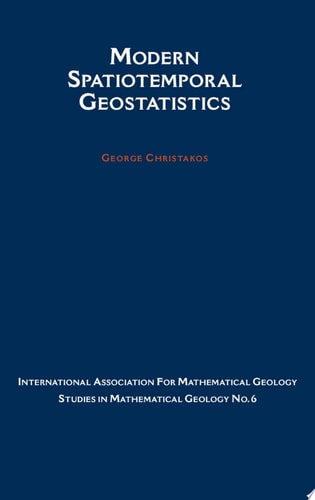
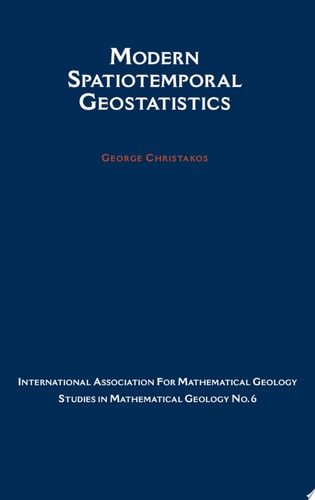
Modern Spatiotemporal Geostatistics
0
0
As an Amazon Associate and affiliate partner, Menrva Books earns from qualifying purchases. Learn more
Author Description
It Is Widely Recognized That The Techniques Of Classical Geostatistics, Which Have Been Used For Several Decades, Have Reached Their Limit, And The Time Has Come For Some Alternative Approaches To Be Given A Chance. This Book, Therefore, Is An Introduction To The Fundamentals Of Modern Geostatistics, Which Is A Group Of Spatiotemporal Concepts And Methods That Are The Products Of The Advancement Of The Epistemic Status Of Stochastic Data Analysis. The Latter Is Considered From A Novel Perspective, Promoting The View That A Deeper Understanding Of A Theory Of Knowledge Is An Important Prerequisite For The Development Of Improved Mathematical Models Of Scientific Mapping. The Main Focus Of The Book Is The Bayesian Maximum Entropy (bme) Approach For Studying Spatiotemporal Distributions Of Natural Variables. As Part Of The Modern Geostatistics Paradigm, The Bme Approach Provides A Fundamental Insight Into The Mapping Problem In Which The Knowledge Of A Natural Variable, Not The Variable Itself, Is The Direct Object Of Study. The Thread Running Throughout The Book Is That The Modern Geostatistical Approach To Environmental Problems Is That Of Natural Scientists Who Are More Interested In A Stochastic Analysis Concerned With Both The Ontological Level(building Models For Physical Systems) And The Epistemic Level (using What We Know About The Physical Systems And Integrating And Modeling Knowledge From A Variety Of Scientific Disciplines), Rather Than In The Pure Naive Inductive Account Of Science Based Merely On A Linear Relationship Between Data And Hypotheses And Theory-free Techniques That May Be Useful In Other Areas.
Menrva's Summary
THE THESIS
This book investigates the limitations of classical geostatistics and proposes a modern, spatiotemporal framework centered on the Bayesian Maximum Entropy (BME) approach. George Christakos, a researcher in stochastic analysis, argues that scientific mapping requires a deeper integration of the theory of knowledge alongside mathematical modeling. By shifting the focus from raw data to the epistemic status of stochastic variables, the author provides a rigorous methodology for analyzing natural systems across both space and time.
THE SCOPE MAP
What You Will Find
- A comprehensive introduction to the Bayesian Maximum Entropy (BME) approach for spatiotemporal mapping.
- Theoretical frameworks for integrating diverse scientific knowledge into stochastic models.
- Methodologies for addressing both the ontological and epistemic levels of physical system modeling.
- A critique of traditional, theory-free inductive techniques in environmental science.
THE AUTHORITY PERSPECTIVE
Experts recognize this work as a foundational text for researchers seeking to move beyond classical geostatistical limitations. Readers frequently note the high level of mathematical and philosophical density required to fully grasp the author's proposed paradigm shift.
Page Count:
312
Publication Date:
2000-01-01
Publisher:
Oxford University Press
ISBN-10:
0198031793
ISBN-13:
9780198031796
Science
Data Analysis
Mathematics
Geology
Statistics
Community Tags
Other Editions(4)

Similar Books
Reader Comments
Share Your Thoughts
No comments yet. Be the first to share your thoughts!