
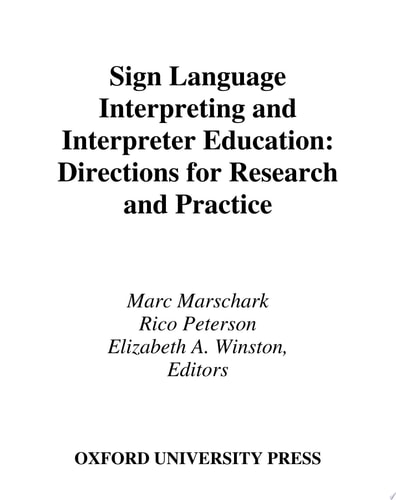
Sign Language Interpreting and Interpreter Education: Directions for Research and Practice
0
0
As an Amazon Associate and affiliate partner, Menrva Books earns from qualifying purchases. Learn more
Author Description
More the 1.46 million people in the United States have hearing losses in sufficient severity to be considered deaf; another 21 million people have other hearing impairments. For many deaf and hard-of-hearing individuals, sign language and voice interpreting is essential to their participation in educational programs and their access to public and private services. However, there is less than half the number of interpreters needed to meet the demand, interpreting quality is often variable, and there is a considerable lack of knowledge of factors that contribute to successful interpreting. Perhaps it is not surprising, then, that a study by the National Association of the Deaf (NAD) found that 70% of the deaf individuals are dissatisfied with interpreting quality. Because recent legislation in the United States and elsewhere has mandated access to educational, employment, and other contexts for deaf individuals and others with hearing disabilities, there is an increasing need for quality sign language interpreting. It is in education, however, that the need is most pressing, particularly because more than 75% of deaf students now attend regular schools (rather than schools for the deaf), where teachers and classmates are unable to sign for themselves. In the more than 100 interpreter training programs in the U.S. alone, there are a variety of educational models, but little empirical information on how to evaluate them or determine their appropriateness in different interpreting and interpreter education-covering what we know, what we do not know, and what we should know. Several volumes have covered interpreting and interpreter education, there are even some published dissertations that have included a single research study, and a few books have attempted to offer methods for professional interpreters or interpreter educators with nods to existing research. This is the first volume that synthesizes existing work and provides a coherent picture of the field as a whole,
Menrva's Summary
THE THESIS
This volume investigates the critical gap between the demand for qualified sign language interpreters and the current state of interpreter education, seeking to establish a coherent research-based framework for the field. The authors, a team of experts in deaf education and linguistics, synthesize existing literature and empirical data to address the systemic lack of standardized evaluation models. By identifying what is known and what remains unknown, the text provides a roadmap for improving interpreting quality in educational and public service settings.
THE SCOPE MAP
What You Will Find
- Analysis of the current shortage of qualified sign language interpreters in the United States.
- Evaluation of diverse educational models currently utilized in over 100 interpreter training programs.
- Synthesis of existing research regarding factors that contribute to successful interpreting outcomes.
- Identification of critical knowledge gaps that hinder professional development and service accessibility.
THE AUTHORITY PERSPECTIVE
Experts recognize this volume as a foundational synthesis that bridges the divide between academic research and practical application in the field of interpreter education. Readers frequently note the text's utility in providing a comprehensive overview of the challenges facing the profession and the necessity for evidence-based training standards.
Page Count:
0
Publication Date:
2005-01-01
Publisher:
Ebsco Publishing
ISBN-10:
019803931X
ISBN-13:
9780198039310
Reference
Education
Social Science
Linguistics
Community Tags
Other Editions(2)
Similar Books













Reader Comments
Share Your Thoughts
No comments yet. Be the first to share your thoughts!