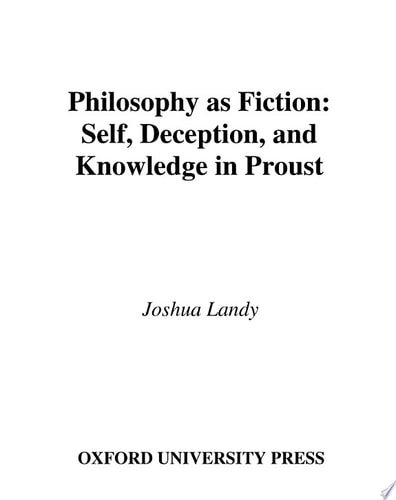
Philosophy As Fiction : Self, Deception, and Knowledge in Proust: Self, Deception, and Knowledge in Proust
0
0
As an Amazon Associate and affiliate partner, Menrva Books earns from qualifying purchases. Learn more
Author Description
Philosophy As Fiction Seeks To Account For The Peculiar Power Of Philosophical Literature By Taking As Its Case Study The Paradigmatic Generic Hybrid Of The Twentieth Century, Marcel Proust's In Search Of Lost Time. At Once Philosophical--in That It Presents Claims, And Even Deploys Arguments Concerning Such Traditionally Philosophical Issues As Knowledge, Self-deception, Selfhood, Love, Friendship, And Art--and Literary, In That Its Situations Are Imaginary And Its Stylization Inescapably Prominent, Proust's Novel Presents Us With A Conundrum. How Should It Be Read? Can The Two Discursive Structures Co-exist, Or Must Philosophy Inevitably Undermine Literature (by Sapping The Narrative Of Its Vitality) And Literature Undermine Philosophy (by Placing Its Claims In The Mouth Of An Often Unreliable Narrator)? In The Case Of Proust At Least, The Result Is Greater Than The Sum Of Its Parts. Not Only Can A Coherent, Distinctive Philosophical System Be Extracted From The Recherche, Once The Narrator's Periodic Waywardness Is Taken Into Account; Not Only Does A Powerfully Original Style Pervade Its Every Nook, Overtly Reinforcing Some Theories And Covertly Exemplifying Others; But Aspects Of The Philosophy Also Serve Literary Ends, Contributing More To Character Than To Conceptual Framework. What Is More, Aspects Of The Aesthetics Serve Philosophical Ends, Enabling A Reader To Engage In An Active Manner With An Alternative Art Of Living. Unlike The Essay Proust Might Have Written, His Novel Grants Us The Opportunity To Use It As A Practice Ground For Cooperation Among Our Faculties, For The Careful Sifting Of Memories, For The Complex Procedures Involved In Self-fashioning, And For The Related Art Of Self-deception. It Is Only Because The Narrator's Insights Do Not Always Add Up--a Weakness, So Long As One Treats The Novel As A Straightforward Treatise--that It Can Produce Its Training Effect, A Feature That Turns Out To Be Its Ultimate Strength.
Menrva's Summary
THE THESIS
How can a work of literature simultaneously function as a rigorous philosophical system without compromising its narrative integrity? Joshua Landy, a scholar of comparative literature and philosophy, investigates this question by analyzing Marcel Proust's In Search of Lost Time. He argues that the novel's inherent contradictions and the unreliability of its narrator are not flaws, but essential mechanisms that transform the text into a practical training ground for the reader's own cognitive and aesthetic faculties.
THE SCOPE MAP
What You Will Find
- A detailed analysis of the intersection between philosophical argumentation and literary stylization in 20th-century fiction.
- A methodological framework for extracting coherent philosophical systems from unreliable narrative structures.
- Case studies focusing on specific themes including self-deception, the nature of selfhood, love, friendship, and the function of art.
- An exploration of how aesthetic form contributes to the reader's active engagement in self-fashioning and memory processing.
THE AUTHORITY PERSPECTIVE
Scholars and critics recognize this work as a significant contribution to the study of the relationship between literature and philosophy. Readers frequently note the academic density of the prose, which is considered a foundational text for those interested in the structural analysis of Proustian aesthetics.
Page Count:
267
Publication Date:
2004-01-01
Publisher:
Oxford University Press, Incorporated
ISBN-10:
0198037880
ISBN-13:
9780198037880
Non-Fiction
Philosophy
Aesthetics
French literature
Literary Criticism
Community Tags
Similar Books

Reader Comments
Share Your Thoughts
No comments yet. Be the first to share your thoughts!