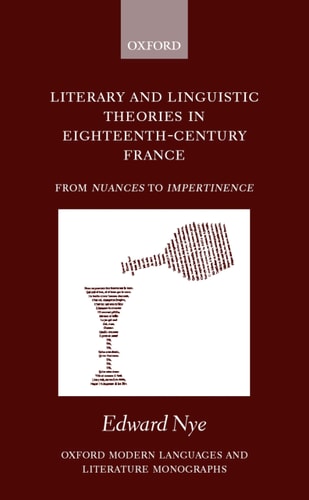
Literary and Linguistic Theories in Eighteenth-Century France: From Nuances to Impertinence
0
0
As an Amazon Associate and affiliate partner, Menrva Books earns from qualifying purchases. Learn more
Author Description
"Linguistic" theories in the eighteenth-century are also theories of literature and art, and it is probably better, therefore, to think of them as "aesthetic" theories. As such, they are answers to the age-old question "what is beauty?," but formulated, also, to respond to contemporary concerns. Edward Nye considers a wide range of authors from these two perspectives and draws the following conclusions: etymology is a theory of poetry, dictionaries of synonymy, prosody and metaphor are theories of preciosity, and Sensualism is a theory of artistic representation.
Menrva's Summary
THE THESIS
This work investigates the intersection of linguistic and aesthetic theories in eighteenth-century France to determine how language studies functioned as a framework for understanding beauty and art. Edward Nye, a scholar of French literature, examines how Enlightenment-era thinkers utilized linguistic tools to address contemporary philosophical concerns. By analyzing the relationship between etymology, prosody, and artistic representation, the author argues that linguistic inquiry was fundamentally inseparable from the period's broader aesthetic discourse.
THE SCOPE MAP
What You Will Find
- Analysis of eighteenth-century French linguistic treatises and their application to art theory
- Examination of etymology as a foundational theory for poetic structure
- Investigation into how dictionaries of synonymy and prosody informed the concept of preciosity
- Application of Sensualist philosophy to the mechanics of artistic representation
THE AUTHORITY PERSPECTIVE
Scholars recognize this monograph as a specialized contribution to the history of ideas and the evolution of French literary theory. Readers frequently note the academic density of the prose, which provides a rigorous examination of how Enlightenment linguistics shaped the aesthetic standards of the era.
Page Count:
264
Publication Date:
2001-05-10
Publisher:
Clarendon Press
ISBN-10:
0198160127
ISBN-13:
9780198160120
History
Philosophy
French literature
Linguistics
Literary Criticism
Aesthetics
Community Tags
Similar Books