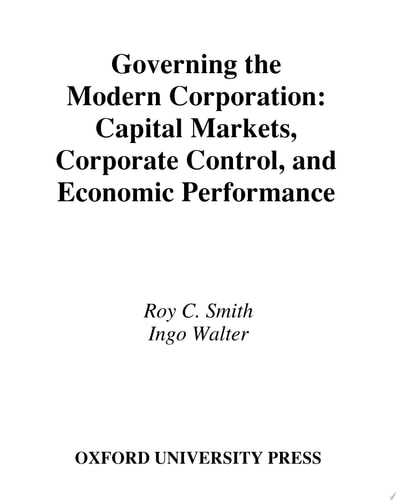
Governing the Modern Corporation
0
0
As an Amazon Associate and affiliate partner, Menrva Books earns from qualifying purchases. Learn more
Author Description
Nearly Seventy Years After The Last Great Stock Market Bubble And Crash, Another Bubble Emerged And Burst, Despite A Thick Layer Of Regulation Designed Since The 1930s To Prevent Such Things. This Time The Bubble Was Enormous, Reflecting Nearly Twenty Years Of Double-digit Stock Market Growth, And Its Bursting Had Painful Consequence. The Search For Culprits Soon Began, And Many Were Discovered, Including Not Only A Number Of Overreaching Corporations, But Also Their Auditors, Investment Bankers, Lawyers And Indeed, Their Investors. In Governing The Modern Corporation, Smith And Walter Analyze The Structure Of Market Capitalism To See What Went Wrong. They Begin By Examining The Developments That Have Made Modern Financial Markets--now Capitalized Globally At About $70 Trillion--so Enormous, So Volatile And Such A Source Of Wealth (and Temptation) For All Players. Then They Report On The Evolving Role And Function Of The Business Corporation, The Duties Of Its Officers And Directors And The Power Of Its Chief Executive Officer Who Seeks To Manage The Company To Achieve As Favorable A Stock Price As Possible. They Next Turn To The Investing Market Itself, Which Comprises Mainly Financial Institutions That Own About Two-thirds Of All American Stocks And Trade About 90% Of These Stocks. These Investors Are Well Informed, Highly Trained Professionals Capable Of Making Intelligent Investment Decisions On Behalf Of Their Clients, Yet The Best And Brightest Ultimately Succumbed To The Bubble And Failed To Carry Out An Appropriate Governance Role. In What Follows, The Roles And Business Practices Of The Principal Financial Intermediaries--notably Auditors And Bankers--are Examined In Detail. All, Corporations, Investors And Intermediaries, Are Found To Have Been Infected By Deep-seated Conflicts Of Interest, Which Add Significant Agency Costs To The Free-market System. The Imperfect, Politicized Role Of The Regulators Is Also Explored, With Disappointing Results. The Entire
Menrva's Summary
THE THESIS
This book investigates the systemic failures of corporate governance and financial oversight that allowed the massive stock market bubble of the late 1990s and early 2000s to emerge and collapse. Roy C. Smith and Ingo Walter utilize their extensive backgrounds in finance and academia to dissect the structural weaknesses within modern market capitalism. They argue that deep-seated conflicts of interest among corporations, institutional investors, and financial intermediaries created significant agency costs that undermined the integrity of the free-market system. By examining the roles of auditors, bankers, and regulators, the authors provide a comprehensive framework for understanding why professional oversight failed to prevent the subsequent economic volatility.
THE SCOPE MAP
What You Will Find
- Analysis of the evolution and function of the modern business corporation and the power dynamics of CEOs.
- Examination of the role of institutional investors who manage the majority of American stock holdings.
- Detailed review of the business practices of financial intermediaries, including auditors and investment bankers.
- Evaluation of the politicized nature of regulatory bodies and their inability to mitigate market instability.
THE AUTHORITY PERSPECTIVE
Experts frequently cite this work as a critical analysis of the structural flaws inherent in the modern financial system. Readers often note the academic rigor and the clear, methodical breakdown of complex agency problems within the corporate landscape.
Page Count:
336
Publication Date:
2005-01-01
Publisher:
Ebsco Publishing
ISBN-10:
0198038321
ISBN-13:
9780198038320
Business
Economics
Corporate governance
Capital market
Finance
Community Tags
Similar Books