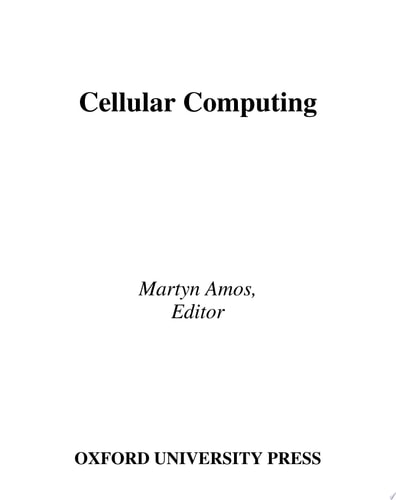
Cellular Computing
0
0
As an Amazon Associate and affiliate partner, Menrva Books earns from qualifying purchases. Learn more
Author Description
The Completion Of The First Draft Of The Human Genome Has Led To An Explosion Of Interest In Genetics And Molecular Biology. The View Of The Genome As A Network Of Interacting Computational Components Is Well-established, But Researchers Are Now Trying To Reverse The Analogy, By Using Living Organisms To Construct Logic Circuits. The Potential Applications For Such Technologies Is Huge, Ranging From Bio-sensors, Through Industrial Applications To Drug Delivery And Diagnostics. This Book Would Be The First To Deal With The Implementation Of This Technology, Describing Several Working Experimental Demonstrations Using Cells As Components Of Logic Circuits, Building Toward Computers Incorporating Biological Components In Their Functioning.
Menrva's Summary
THE THESIS
This book investigates the feasibility and implementation of using living biological cells as functional components within computational logic circuits. Martyn Amos, a researcher in the field of unconventional computing, synthesizes the intersection of molecular biology and computer science. He argues that the genome functions as a network of computational components, proposing that this biological architecture can be repurposed to build synthetic logic systems. The text provides a framework for understanding how biological entities can be engineered to perform tasks traditionally reserved for silicon-based hardware.
THE SCOPE MAP
What You Will Find
- Theoretical foundations of the genome as a computational network
- Experimental methodologies for constructing logic circuits from living cells
- Case studies of bio-sensors and diagnostic applications
- Analysis of industrial potential for biological computing systems
THE AUTHORITY PERSPECTIVE
Experts recognize this work as a foundational text for those exploring the early stages of synthetic biology and unconventional computing. Readers frequently note the technical density of the prose, which assumes a baseline knowledge of molecular biology and logic design.
Page Count:
240
Publication Date:
2004-01-01
Publisher:
Oxford University Press
ISBN-10:
0198035373
ISBN-13:
9780198035374
Science
Technology
Computer Science
Biology
Genetics
Community Tags
Similar Books