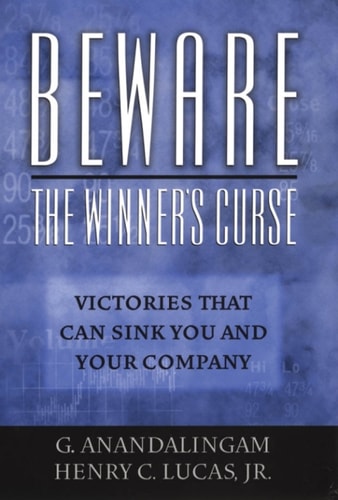
Beware the Winner's Curse: Victories that Can Sink You and Your Company
0
0
As an Amazon Associate and affiliate partner, Menrva Books earns from qualifying purchases. Learn more
Author Description
In the roaring 1990s, many companies seemed to claim great victories-acquiring another company, obtaining state-of-the art technology, or hiring a potential CEO savior-only to find that they had made a great mistake. The term "Winner's Curse" was coined by economists to explain an effect commonly observed in auctions. In such situations, since the winning bidder is usually the most optimistic about the value of the item being auctioned, there is a very good chance that the bid will be more (sometimes much more) than the item is worth. So a company that overvalues a good or service, or bids higher than its value has the potential of experiencing this Winner's Curse. In this book, G. Anandalingam and Henry C. Lucas, Jr. expand the model of the Winner's Curse to explain how companies like Tyco, MCI-WorldCom and Bank One overpaid for acquisitions, and how shareholders suffered as a result. They elucidate the disasters that happened during the rush to acquire new technologies and illuminate the reasons that companies that were seemingly pioneers in the dot-com era fell by the wayside. Beginning by exploring the psychological, personal and market factors that can encourage a decision maker to overvalue an asset and experience the Winner's Curse, the book goes on to examine several case studies, including the disastrous wireless spectrum auctions that have devastated the telecommunications industry, and the dot-com bust. It concludes by discussing ways to avoid the Winner's Curse, calling for major changes in the behavior of CEOs and members of boars of directors, as well as the use of powerful techniques for analyzing decisions, including a systems approach to decision making, scenario analysis and game theory.
Menrva's Summary
THE THESIS
This book investigates the economic and psychological mechanisms that lead corporate decision-makers to overvalue assets, resulting in the phenomenon known as the Winner's Curse. Authors G. Anandalingam and Henry C. Lucas Jr. utilize their expertise in decision sciences and information systems to analyze why high-profile acquisitions and technology investments often fail. They argue that by understanding the cognitive biases and market pressures inherent in competitive bidding, organizations can implement more rigorous analytical frameworks to protect shareholder value.
THE SCOPE MAP
What You Will Find
- Analysis of corporate failures including Tyco, MCI-WorldCom, and Bank One.
- Examination of the telecommunications wireless spectrum auctions and the dot-com era collapse.
- Application of decision-making tools such as game theory, scenario analysis, and systems thinking.
- Exploration of the psychological and personal factors influencing executive decision-making.
THE AUTHORITY PERSPECTIVE
Experts and business professionals frequently cite this work as a practical application of economic theory to real-world corporate governance. Readers often note that the text provides a clear, accessible bridge between academic auction theory and the high-stakes environment of executive management.
Page Count:
256
Publication Date:
2004-01-01
Publisher:
Oxford University Press
ISBN-10:
0198039441
ISBN-13:
9780198039440
Economics
Business
Corporate Finance
Decision Making
Consolidation & Merger
Principles of Management
Management
Strategy
Community Tags
Similar Books