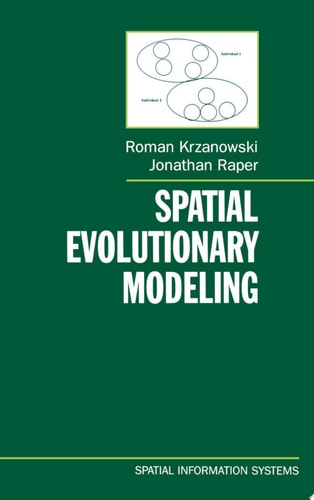
Spatial Evolutionary Modeling (Spatial Information Systems)
0
0
As an Amazon Associate and affiliate partner, Menrva Books earns from qualifying purchases. Learn more
Author Description
Evolutionary models (e.g., genetic algorithms, artificial life), explored in other fields for the past two decades, are now emerging as an important new tool in GIS for a number of reasons. First, they are highly appropriate for modeling geographic phenomena. Secondly, geographical problems are often spatially separate (broken down into local or regional problems) and evolutionary algorithms can exploit this structure. Finally, the ability to store, manipulate, and visualize spatial data has increased to the point that space-time-attribute databases can be easily handled.
Menrva's Summary
THE THESIS
This book investigates the integration of evolutionary computational models into Geographic Information Systems (GIS) to solve complex spatial problems. The authors, Jonathan Raper and Roman M. Krzanowski, leverage their expertise in spatial information systems to argue that evolutionary algorithms—such as genetic algorithms and artificial life simulations—provide a robust framework for analyzing geographic phenomena. By synthesizing advancements in spatial data storage and visualization, the text establishes a methodology for applying these computational tools to regional and local spatial challenges.
THE SCOPE MAP
What You Will Find
- Theoretical foundations of evolutionary algorithms applied to spatial data
- Methodologies for decomposing geographic problems into local or regional units
- Analysis of space-time-attribute database management
- Case studies demonstrating the visualization of evolutionary spatial models
THE AUTHORITY PERSPECTIVE
Experts recognize this text as a foundational resource for understanding the intersection of computational intelligence and spatial analysis. Readers frequently note the technical density of the prose, which serves as a specialized reference for GIS professionals and researchers.
Page Count:
244
Publication Date:
2001-01-01
Publisher:
Oxford University Press
ISBN-10:
0198031017
ISBN-13:
9780198031017
Science
Data Analysis
Professional Career & Trade
Technology
Earth Sciences
Geology
Computer Science
Geography
Community Tags
Similar Books