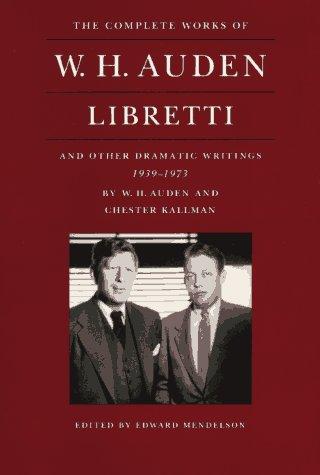
W.H. Auden and Chester Kallman
0
0
As an Amazon Associate and affiliate partner, Menrva Books earns from qualifying purchases. Learn more
Author Description
W. H. Auden called opera the "last refuge of the High Style," and considered it the one art in which the grand manner survived the ironic levelings of modernity. He began writing libretti soon after he arrived in America in 1939 and abandoned his earlier attempts to write public, political drama. Opera gave him the opportunity to rise to the high style in public, not in an attempt to elevate his own status as a poet, but in service of the heroic voice of the singers. These works present their mythical actions with a direct intensity unlike anything in even his greatest poems. In this volume of Auden and Chester Kallman's libretti, extensive historical and textual notes trace the history of the production and revision of the works and provide full texts of early scenarios, as well as abandoned and rewritten scenes. Almost all the works included here were previously published in incomplete and often inaccessible editions - or were never published at all. The book prints for the first time the full text of Paul Bunyan, Auden's first libretto, which he wrote for music by Benjamin Britten. It also includes Auden and Kallman's The Rake's Progress, written for Igor Stravinsky, and Delia, written for Stravinsky but never set to music. The work continues with Auden and Kallman's two libretti written for music by Hans Werner Henze, Elegy for Young Lovers and The Bassarids, and their adaptation of Love's Labour's Lost, composed by Nicolas Nabokov. It also contains their translation of The Magic Flute, with its scenes reordered for greater dramatic coherence and added dialogue for sharper mythical significance, and their antimasque, The Entertainment of the Senses, for music by John Gardner. The book contains two radio plays - The Dark Valley, a monologue written by Auden alone, and The Rocking Horse Winner, written with James Stern and based on a story by D. H. Lawrence. Also included are the unpublished masque that Auden wrote for Kallman's twenty-second birthday, the un
Menrva's Summary
THE THESIS
This volume explores the significant collaboration between the renowned poet W. H. Auden and his brother, Chester Kallman, focusing on their work as librettists for opera and other musical forms. Auden viewed opera as a vital art form capable of sustaining a 'High Style' in the face of modern irony, and his collaboration with Kallman allowed him to engage with this grand manner, serving the expressive power of singers rather than seeking personal elevation. The collection presents these libretti, tracing their production and revision with extensive notes, early scenarios, and abandoned scenes, offering a comprehensive look at a crucial aspect of Auden's later career.
THE SCOPE MAP
- The full text of Paul Bunyan, Auden's first libretto for Benjamin Britten.
- The libretti for Igor Stravinsky's The Rake's Progress and Delia (the latter never set to music).
- Libretti for Hans Werner Henze's Elegy for Young Lovers and The Bassarids.
- Auden and Kallman's adaptation of Love's Labour's Lost for Nicolas Nabokov.
- Their translation of Mozart's The Magic Flute, with reordered scenes and added dialogue.
- The antimasque The Entertainment of the Senses for John Gardner.
- Two radio plays: Auden's The Dark Valley and The Rocking Horse Winner (with James Stern).
- An unpublished masque written by Auden for Chester Kallman's birthday.
THE AUTHORITY PERSPECTIVE
This collection is regarded as an essential resource for scholars and enthusiasts of W. H. Auden's work, particularly his engagement with opera and musical theatre. The inclusion of previously unpublished or inaccessible texts, alongside detailed historical and textual notes, provides significant scholarly value. The meticulous tracing of production histories and the presentation of early drafts offer deep insights into the creative process of Auden and Kallman. The volume is recognized for its comprehensive scope and its contribution to understanding Auden's late career and his unique approach to the 'High Style' in opera.
Page Count:
758
Publication Date:
1993-01-01
ISBN-10:
0691033013
Non-Fiction
Poetry
Biography
Drama
Literary Criticism
Community Tags
Similar Books