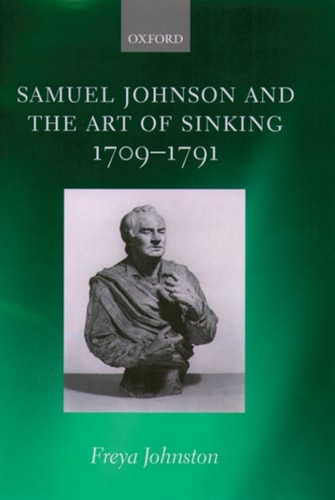
Samuel Johnson and the Art of Sinking: 1709-1791
0
0
As an Amazon Associate and affiliate partner, Menrva Books earns from qualifying purchases. Learn more
Author Description
The traditional view of Samuel Johnson as hostile to particulars, trifles, and aesthetic mediocrity only half-explains his authorial character. Samuel Johnson and the Art of Sinking 1709-1791 argues that, in a period dominated by social and literary hierarchies, Johnson's works reveal a defining interest in 'little', 'mean', or 'low' topics and people. Freya Johnston moves away from a critical emphasis on what literature of this period excludes, to consider its modes of including recalcitrant material. Of necessity finite, any piece of writing is informed by the subject matter it omits or to which it indirectly alludes. How can we identify the peripheral topics or characters purportedly 'excluded' from a text, unless it provides compelling inferences that oblige us to supply the omission? In which case, something subtler is at work than barefaced proscription. Rehearsing the comparative merits of great and little things, Johnson and his contemporaries tested the opposing claims of pagan and Christian authority. Ancient criticism, and its eighteenth-century adherents, held that each subject required an appropriate style: little matters call for the low, lofty ones for the high. Yet Gospel writers stressed Christ's incarnation as a praiseworthy and imitable descent to the humanly little -- one that is compatible with the most sublime style. Through a series of close readings, this book examines how Johnson conceived of his relationships to and with the margins of writing and of society. It proposes that his literary and critical practice is neither inclusive nor exclusive in its attitudes towards peripheral things.
Menrva's Summary
THE THESIS
This book investigates how Samuel Johnson’s literary works and critical practices engaged with 'low' or 'peripheral' subjects, challenging the traditional view that he was solely concerned with high-minded aesthetic ideals. Freya Johnston, a scholar of eighteenth-century literature, utilizes close readings of Johnson’s texts to argue that his writing navigated the tension between classical stylistic hierarchies and the Christian emphasis on the significance of the humble. By examining how Johnson incorporated excluded or 'mean' topics, the author demonstrates that his work functioned through a complex negotiation of inclusion and omission rather than simple proscription.
THE SCOPE MAP
What You Will Find
- Analysis of eighteenth-century literary hierarchies and the 'art of sinking' in writing.
- Close readings of Samuel Johnson’s essays, criticism, and prose.
- Exploration of the theological and classical influences on Johnson’s stylistic choices.
- Discussion of the relationship between the 'sublime' and the 'little' in literature.
Scope Limits
- The book does not provide a comprehensive chronological biography of Johnson’s life.
- It does not cover the entirety of the eighteenth-century literary canon, focusing primarily on Johnson’s specific aesthetic and critical framework.
THE AUTHORITY PERSPECTIVE
Scholars and critics recognize this work as a nuanced contribution to Johnsonian studies that successfully complicates established views on his aesthetic priorities. Readers often note the academic density of the prose, which is intended for an audience familiar with eighteenth-century literary theory and classical criticism.
Page Count:
282
Publication Date:
2005-01-01
Publisher:
Oxford University Press
ISBN-10:
0191530778
ISBN-13:
9780191530777
History
Biography
English
Literary Criticism
18th century
English & College Success
Samuel Johnson
English literature
Community Tags
Similar Books