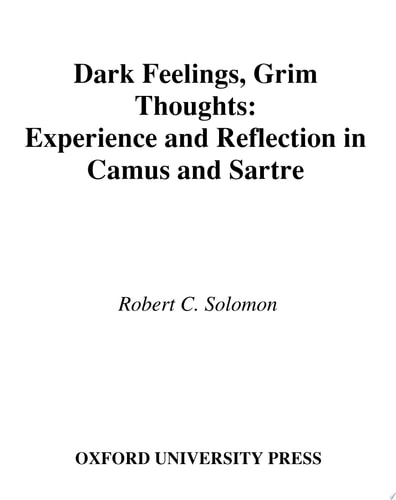
Dark Feelings, Grim Thoughts: Experience and Reflection in Camus and Sartre
0
0
As an Amazon Associate and affiliate partner, Menrva Books earns from qualifying purchases. Learn more
Author Description
In the same spirit as his most recent book, Living With Nietzsche, and his earlier study In the Spirit of Hegel, Robert Solomon turns to the existential thinkers Albert Camus and Jean-Paul Sartre, in an attempt to get past the academic and political debates and focus on what is truly interesting and valuable about their philosophies. Solomon makes the case that--despite their very different responses to the political questions of their day--Camus and Sartre were both fundamentally moralists, and their philosophies cannot be understood apart from their deep ethical commitments. He focuses on Sartre's early, pre-1950 work, and on Camus's best known novels The Stranger, The Plague, and The Fall. Throughout Solomon makes the important point that their shared interest in phenomenology was much more important than their supposed affiliation with "existentialism." Solomon's reappraisal will be of interest to anyone who is still or ever has been fascinated by these eccentric but monumental figures.
Menrva's Summary
THE THESIS
This book investigates the core ethical commitments of Albert Camus and Jean-Paul Sartre, arguing that their philosophies are best understood as fundamentally moral projects rather than mere existentialist doctrine. Robert C. Solomon, a noted philosopher, utilizes his expertise in continental thought to move beyond historical political debates surrounding these figures. He examines the intersection of phenomenology and ethics, asserting that the moral urgency within their work remains the most significant aspect of their intellectual legacy. By focusing on specific texts and early career developments, Solomon provides a framework for re-evaluating their contributions to modern moral philosophy.
THE SCOPE MAP
What You Will Find
- Analysis of Jean-Paul Sartre's philosophical output prior to 1950
- Critical examination of Albert Camus's major novels including The Stranger, The Plague, and The Fall
- A comparative study of the role of phenomenology in both authors' work
- An argument for reclassifying these thinkers as moralists rather than strictly existentialists
THE AUTHORITY PERSPECTIVE
Scholars and students of continental philosophy frequently cite this work as a clarifying text that strips away the baggage of mid-century political polemics. Readers often note the accessibility of Solomon's prose, which makes complex phenomenological concepts understandable for those outside of specialized academic circles.
Page Count:
241
Publication Date:
2006-01-01
Publisher:
Oxford University Press
ISBN-10:
0198040105
ISBN-13:
9780198040101
Biography
Politics
Philosophy
Kindle eBooks
Criticism & Theory
Movements
Existentialism
Kindle Store
Categories
Literary Criticism
Ethics
Community Tags
Other Editions(2)
Similar Books