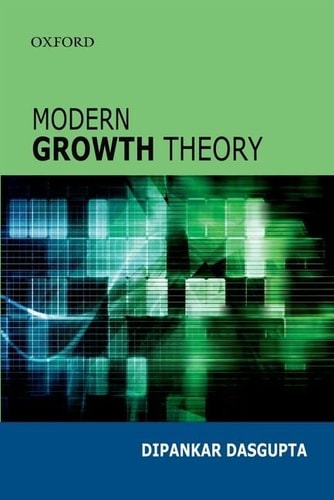
Modern Growth Theory
Author Description
The book deals with Growth Theory, one of the most interesting as well as important subjects universities across the world teach at the Master's level. It is based on lectures delivered to Master's level students and Research Scholars at the Indian Statistical Institute, the Jawaharlal Nehru University, the Delhi School of Economics, the Indian Institute of Technology, Kharagpur, Kobe University, Japan, and the City University of Hong Kong. In order to take into account student inputs, several batches of students were exposed to the ideas presented here, who provided their feedbacks to the author.The book provides an in depth treatment of Old Growth Theory and then follows it up with the best known works in New Growth Theory. In addition, to ensure that the book serves the purpose of a classroom textbook, the exercises have been added at the end of each chapter that teachers can use to test the understanding of the students. The first two chapters deal with Control Theory which is explained in detail with reference to the best known of Growth Theory Models, viz. Robert Solow's neoclassical model of growth. These ideas extend easily to the later chapters as well.The first two chapters of the book can be used for a first year Master's level course in Macroeconomics as well, though the book as a whole deals with the subject of Economic Growth, which is usually taught as a special paper at the second year Master's level. Finally, given that the book starts off with numerical examples relating to the Indian economy, it should appeal to students studying in Indian universities.
Menrva's Summary
THE THESIS
This book investigates the theoretical foundations and mathematical models of economic growth, bridging the gap between classical neoclassical models and contemporary growth theories. Dipankar Dasgupta, drawing on his extensive teaching experience at institutions such as the Indian Statistical Institute and the Delhi School of Economics, synthesizes lecture material into a structured pedagogical framework. The text utilizes rigorous mathematical analysis and control theory to explain how economies evolve, providing a comprehensive resource for graduate-level students and researchers.
THE SCOPE MAP
What You Will Find
- Detailed application of Control Theory to neoclassical growth models.
- Comparative analysis between Old Growth Theory and New Growth Theory frameworks.
- Practical numerical examples derived from the Indian economy to illustrate theoretical concepts.
- End-of-chapter exercises designed for classroom assessment and student comprehension testing.
THE AUTHORITY PERSPECTIVE
Experts and educators recognize this text as a robust resource for Master's level macroeconomics courses, particularly for its clear integration of mathematical tools with economic theory. Readers frequently note the academic density of the prose, which is tailored specifically for students and researchers familiar with advanced economic modeling.
Page Count:
280
Publication Date:
2011-03-24
Publisher:
Oxford University Press
ISBN-10:
0198069960
ISBN-13:
9780198069966
Economics
Categories
Macroeconomics
Kindle eBooks
textbook
Academic
Kindle Store
Community Tags
Similar Books