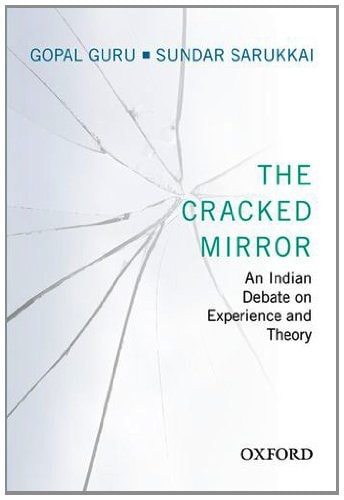
The Cracked Mirror: An Indian Debate on Experience and Theory
0
0
As an Amazon Associate and affiliate partner, Menrva Books earns from qualifying purchases. Learn more
Author Description
Product Description This volume explores the relationship between experience and theory in Indian social sciences in the form of a dialogue. It focuses on questions of Dalit experience and untouchability. While Gopal Guru argues that only those who have lived lives as subalterns can represent them accurately,Sundar Sarukkai feels that people located outside the community can also represent them. Thematically divided into five sections, the first discusses the problems associated with theory in the social sciences in the Indian context. The next makes inquiries into the nature of personal and collectiveexperience. The third explores the larger connection between ethics and theory in India, both in the natural and social sciences. The fourth examines the ontological and epistemological nature of experience itself and the politics of experience, and the last focuses on the experience and theory ofexperience in India. The authors invoke the image of a cracked mirror to suggest a more complex and distorted relation between experience and theory.This book will interest scholars, researchers, and students of Dalit studies, subaltern studies, and politics. About the Author Gopal Guru is Professor, Centre for Political Studies, Jawaharlal Nehru University, New Delhi.Sundar Sarukkai is Professor and Director, Manipal Centre for Philosophy and Humanities, Manipal University, Karnataka. Also, former Professor of Philosophy, National Institute of Advanced Studies, Bengaluru.
Menrva's Summary
THE THESIS
This volume investigates the complex, often distorted relationship between lived experience and theoretical representation within the context of Indian social sciences. Gopal Guru and Sundar Sarukkai, both distinguished academics in political studies and philosophy, engage in a structured dialogue to address the tension between subaltern lived reality and academic theorization. By examining the politics of untouchability and the nature of knowledge production, the authors argue that the mirror of theory reflects experience in a fragmented and incomplete manner.
THE SCOPE MAP
What You Will Find
- A critical analysis of the methodological challenges inherent in Indian social science research.
- A philosophical inquiry into the ontological and epistemological status of personal and collective experience.
- A thematic exploration of the intersection between ethics, theory, and the natural sciences.
- A debate regarding the legitimacy of representation by those outside the subaltern community.
THE AUTHORITY PERSPECTIVE
Scholars and researchers in the fields of Dalit and subaltern studies identify this work as a foundational text for understanding the limitations of academic discourse. Readers frequently note the intellectual density of the prose, which requires a strong background in philosophical inquiry to fully grasp the authors' arguments.
Page Count:
264
Publication Date:
2012-08-02
Publisher:
Oxford University Press
ISBN-10:
0198078315
ISBN-13:
9780198078319
Politics
Philosophy
Epistemology
Dalit Studies
Caste
Social Science
Kindle Store
World politics
Categories
Kindle eBooks
Community Tags
Similar Books