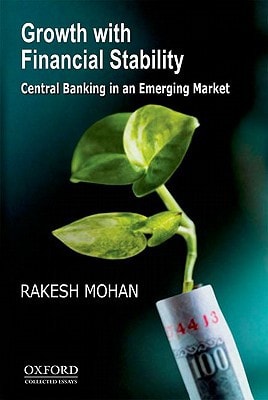
Growth with Financial Stability: Central Banking in an Emerging Market
0
0
As an Amazon Associate and affiliate partner, Menrva Books earns from qualifying purchases. Learn more
Author Description
It is widely believed that the Indian economy witnessed near stagnation in real GDP growth from Independence till the late 1970s. Challenging this notion, the collection of papers and speeches in this volume provides fresh perspectives on India's growth experience from Independence to the recent global financial crisis. This volume documents how the conduct of Indian monetary and financial policy has been unorthodox by the standards of extant international conventional wisdom, but appropriate to the macroeconomic and structural conditions prevailing in India.With a focus on growth drivers and financial stability, the volume deals with a wide-range of issues: growth of manufacturing and service sectors, role of policies (monetary, fiscal, financial market and sector, external sector), urban infrastructure investment, public service delivery, role of central banks, and the interaction between international finance and monetary policy. Drawing upon the post-reform experience and the global crisis, the volume takes stock of current challenges and suggests strategies to sustain long-term double-digit growth rates.
Menrva's Summary
THE THESIS
This volume investigates whether India's monetary and financial policies, often viewed as unorthodox by international standards, were effectively calibrated to the nation's unique macroeconomic and structural conditions. Rakesh Mohan, a former Deputy Governor of the Reserve Bank of India, leverages his extensive experience in central banking and public policy to analyze India's economic trajectory from Independence through the global financial crisis. The work argues that India's growth experience has been misunderstood and provides a framework for understanding how specific policy interventions in manufacturing, infrastructure, and finance have shaped long-term development.
THE SCOPE MAP
What You Will Find
- Analysis of India's economic growth drivers from the post-Independence era to the post-reform period.
- Examination of monetary, fiscal, and financial market policies within an emerging market context.
- Assessment of the role of central banks in managing international finance and domestic stability.
- Strategies for sustaining long-term double-digit growth rates in the face of current global challenges.
THE AUTHORITY PERSPECTIVE
Experts recognize this collection as a significant contribution to the study of central banking in developing economies. Readers frequently note the technical depth of the analysis, which provides a clear view into the practical application of economic policy in India.
Page Count:
520
Publication Date:
2011-09-25
Publisher:
Oxford University Press
ISBN-10:
0198070209
ISBN-13:
9780198070207
Economics
Finance
Public Policy
Banking
Macroeconomics
India
Community Tags
Similar Books