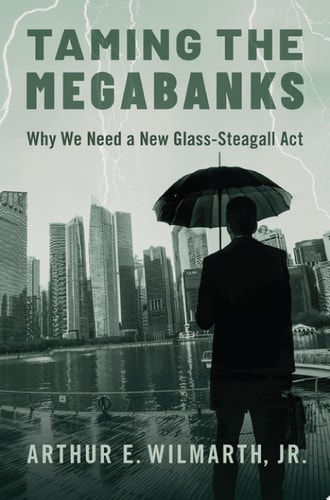
Taming the Megabanks: Why We Need a New Glass-Steagall Act
0
0
As an Amazon Associate and affiliate partner, Menrva Books earns from qualifying purchases. Learn more
Author Description
Banks were allowed to enter securities markets and become universal banks during two periods in the past century - the 1920s and the late 1990s. Both times, universal banks made high-risk loans and packaged them into securities that were sold as safe investments to poorly-informed investors. Both times, universal banks promoted unsustainable booms that led to destructive busts - the Great Depression of the early 1930s and the Global Financial Crisis of 2007-09. Both times, governments were forced to arrange costly bailouts of universal banks. Congress passed the Glass-Steagall Act of 1933 in response to the Great Depression. The Act broke up universal banks and established a decentralized financial system composed of three separate and independent sectors: banking, securities, and insurance. That system was stable and successful for over four decades until the big-bank lobby persuaded regulators to open loopholes in Glass-Steagall during the 1980s and convinced Congress to repeal it in 1999. Congress did not adopt a new Glass-Steagall Act after the Global Financial Crisis. Instead, Congress passed the Dodd-Frank Act. Dodd-Frank's highly technical reforms tried to make banks safer but left in place a dangerous financial system dominated by universal banks. Universal banks continue to pose unacceptable risks to financial stability and economic and social welfare. They exert far too much influence over our political and regulatory systems because of their immense size and their undeniable "too-big-to-fail" status. In Taming the Megabanks, Arthur Wilmarth argues that we must again separate banks from securities markets to avoid another devastating financial crisis and ensure that our financial system serves Main Street business firms and consumers instead of Wall Street bankers and speculators. Wilmarth's comprehensive and detailed analysis demonstrates that a new Glass-Steagall Act would make our financial system much more stable and less likely to produce boom-and-bust cycles.
Menrva's Summary
THE THESIS
The central question investigated is whether the structural separation of commercial and investment banking, as mandated by the original Glass-Steagall Act, is necessary to prevent future systemic financial crises. Arthur E. Wilmarth, a professor emeritus of law with extensive expertise in financial regulation, utilizes historical analysis and comparative economic data to argue that the current universal banking model is inherently unstable. He posits that the repeal of Glass-Steagall facilitated the conditions for both the Great Depression and the 2007-09 Global Financial Crisis, suggesting that current regulatory frameworks like Dodd-Frank are insufficient to mitigate the risks posed by institutions that are too big to fail.
THE SCOPE MAP
What You Will Find
- Historical comparison of financial market behavior in the 1920s and the 1990s.
- Analysis of the legislative history and subsequent repeal of the Glass-Steagall Act.
- Evaluation of the limitations of the Dodd-Frank Act in addressing systemic risk.
- Arguments regarding the political influence of large financial institutions.
Scope Limits
- The text focuses primarily on the United States financial system.
- It does not provide a detailed technical manual for individual investment strategies.
THE AUTHORITY PERSPECTIVE
Experts and policy analysts recognize this work as a rigorous, historically grounded critique of modern financial deregulation. Readers frequently note the academic density of the prose, which provides a comprehensive legal and economic framework for understanding the necessity of structural banking reform.
Page Count:
597
Publication Date:
2020-01-01
Publisher:
Oxford University Press
ISBN-10:
0190260726
ISBN-13:
9780190260729
Economics
History
Professional Career & Trade
Comparative Politics
Public Policy
Economics history
Banking
Money & BankingMonetary Theory
Finance
Community Tags
Other Editions(2)
Similar Books







Reader Comments
Share Your Thoughts
No comments yet. Be the first to share your thoughts!