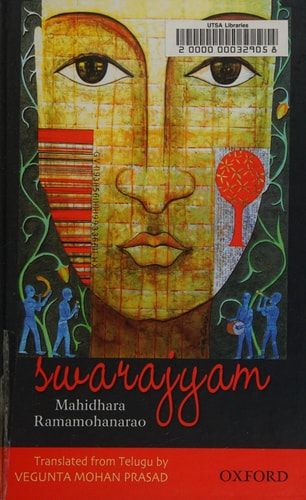
Swarajyam
0
0
As an Amazon Associate and affiliate partner, Menrva Books earns from qualifying purchases. Learn more
Author Description
It is 1921 and the ripples of the Freedom Movement have reached the quiet village of Munganda. The stage is set for the dramatis personae: an idealistic young Brahmin, Ramanatham, an admirer of Gandhi; an intelligent young woman, Swarajyam, who instinctively yearns for liberation from stifling social mores and discrimination; and a village with a full cast of characters who strive to cling to the past while being inevitably drawn into a very different future. Munganda village is a microcosm of a newly resurgent India which is resonating with Gandhi's clarion call for political and social liberation. As the novel unfolds, we see Ramanatham battling his own inner doubts while trying to spread Gandhi's message of change. We see Swarajyam, dutiful daughter and abandoned wife, who dares to be different. This is a novel set almost one hundred years ago; yet it remains relevant for its insights into human hopes and fears and its portrayal of the continual tussle between tradition and modernity, both in thought and choices. The Introduction by M. Sridhar and Alladi Uma shows how Swarajyam (meaning 'freedom') holds a special significance for the country more than forty years after the publication of the Telugu original, which received the prestigious Andhra Pradesh Sahitya Akademi Award in 1969.
Menrva's Summary
THE PULSE
The arrival of the 1921 Indian Freedom Movement in the village of Munganda forces its inhabitants to confront the inevitable collision between rigid traditionalism and the promise of social reform. Ramanatham, an idealistic Brahmin, attempts to disseminate Gandhian principles while grappling with his own internal hesitations regarding the efficacy of his mission. Simultaneously, Swarajyam, a woman navigating the constraints of being an abandoned wife, seeks personal liberation from the oppressive social mores governing her existence. The narrative operates as a character-driven study of a community caught in the transition toward a new national identity, utilizing a third-person perspective to observe the shifting dynamics of the village.
INSIDE THE PAGES
- Exploration of the intersection between political independence and personal autonomy.
- Detailed depiction of early 20th-century rural Indian social hierarchies.
- Character study of the conflict between Brahminical tradition and modern reformist ideals.
- Examination of the role of women in the context of the Indian freedom struggle.
- Use of the village of Munganda as a microcosm for national change.
- Integration of Gandhian philosophy as a catalyst for individual and communal transformation.
- Analysis of the psychological toll of societal abandonment on the female protagonist.
- Portrayal of the tension between historical preservation and the necessity of progress.
THE COLLECTIVE ECHO
Readers and critics frequently highlight the novel's ability to capture the atmosphere of a changing India during a pivotal historical era. Discussion often centers on the nuanced characterization of Swarajyam, whose personal quest for freedom mirrors the broader national aspirations of the time. The prose is noted for its balance between intimate character development and the broader political stakes of the Gandhian movement. Critics emphasize that the work remains significant for its exploration of the enduring struggle between tradition and modernity, making it a staple of regional literature that resonates beyond its original cultural context.
Page Count:
384
Publication Date:
2012-02-03
Publisher:
Oxford University Press
ISBN-10:
0198077378
ISBN-13:
9780198077374
Coming of Age
Historical
Fiction political
Indian
Political
Social Issues
India
Community Tags
Similar Books