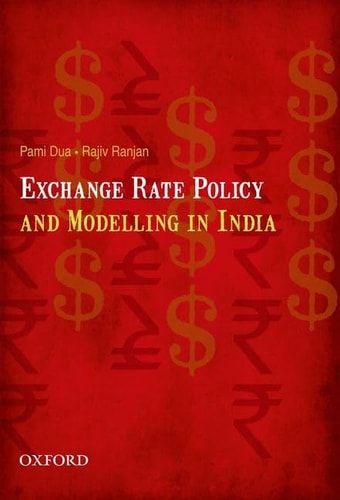
Exchange Rate Policy and Modelling in India
0
0
As an Amazon Associate and affiliate partner, Menrva Books earns from qualifying purchases. Learn more
Author Description
Exchange rate fluctuations affect the value of international investment portfolios, competitiveness of exports and imports, value of international reserves, currency value of debt payments, and the cost to tourists in terms of the value of their currency. Movements in exchange rates, therefore, have significant implications for the economy's business cycle, trade, and capital flows. This book provides a comprehensive analysis of the foreign exchange market in India in terms of participants, instruments and the trading platform, as also turnover and forward premia.The book covers four broad areas: (i) various facets of economic policy with respect to the exchange rate; (ii) the recent global financial crisis and the role of exchange rates therein; (iii) the pattern of capital flows and capital account liberalization; and (iv) modelling and forecasting the exchange rate. The authors contextualize the evolution of the Indian foreign exchange market from a highly regulated market to a deep, liquid, and efficient market in the 1990s, and focus on how large capital flows have impacted the exchange rate policy. More important, they develop a model for the rupee-dollar exchange rate taking into account variables from monetary and micro structure models as well as other variables such as central bank intervention.
Menrva's Summary
THE THESIS
This book investigates the mechanics of the Indian foreign exchange market and the efficacy of various policy frameworks in managing rupee volatility. Pami Dua and Rajiv Ranjan utilize their extensive academic and policy-oriented backgrounds to synthesize historical data and economic theory. They present a rigorous framework that evaluates the transition of the Indian market from a regulated environment to a liquid, modern system, while providing a quantitative model for forecasting exchange rate movements.
THE SCOPE MAP
What You Will Find
- Analysis of the evolution of the Indian foreign exchange market since the 1990s.
- Examination of the impact of global financial crises on domestic exchange rate stability.
- Quantitative modeling techniques for the rupee-dollar exchange rate incorporating central bank intervention.
- Evaluation of capital account liberalization and its influence on trade and capital flows.
THE AUTHORITY PERSPECTIVE
Experts identify this work as a technical resource for understanding the intersection of monetary policy and micro-structure models in emerging markets. Readers frequently note the academic density of the prose, which serves as a foundational text for students and practitioners of Indian macroeconomics.
Page Count:
272
Publication Date:
2012-01-01
Publisher:
Oxford University Press
ISBN-10:
0198077203
ISBN-13:
9780198077206
Economics
India
International Trade
Finance
Community Tags
Similar Books