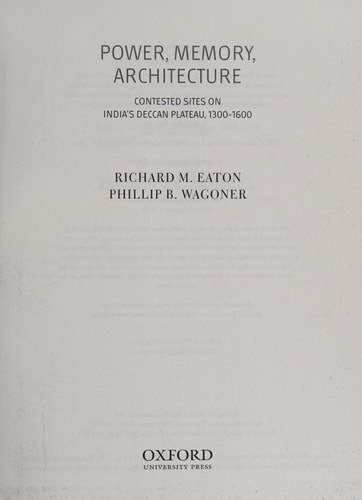
Power, Memory, Architecture: Contested Sites on India's Deccan Plateau, 1300-1600
0
0
As an Amazon Associate and affiliate partner, Menrva Books earns from qualifying purchases. Learn more
Author Description
Most studies of the history of the early modern Deccan focus on struggles between the region's primary centers, that is, the great capital cities such as Bijapur, Vijayanagara, or Golconda. This study, by contrast, examines the political histories and material culture of smaller, fortified strongholds both on the plains and atop hills, the control of which was repeatedly contested by rival primary centers. Exceptionally high levels of conflict over such secondary centers occurred between 1300 and 1600, and especially during the turbulent sixteenth century when gunpowder technology had become widespread in the region.The authors bring two principal objectives to the enquiry. One is to explore how political power, monumental architecture, and collective memory interacted with one another in the period under study. The study's authors-one trained in history, the other in art history and archaeology-argue for systematically integrating the methodologies of history, art history, and archaeology in attempts to reconstruct the past. The study's other aim is to radically rethink the usefulness of Hindu-Muslim relations as the master key by which to interpret this period of South Asian history, and to propose instead a model informed by Sanskrit and the Persian literary traditions.
Menrva's Summary
THE THESIS
This study investigates how political power, monumental architecture, and collective memory intersected within the contested secondary strongholds of the Deccan Plateau between 1300 and 1600. The authors, Phillip B. Wagoner and Richard M. Eaton, utilize their combined expertise in history, art history, and archaeology to challenge traditional interpretations of this era. By moving away from the binary focus on Hindu-Muslim relations, they propose a new analytical framework grounded in Sanskrit and Persian literary traditions to better understand the region's complex political landscape.
THE SCOPE MAP
What You Will Find
- Analysis of fortified strongholds located on plains and hilltops across the Deccan Plateau.
- Integration of historical, art historical, and archaeological methodologies to reconstruct regional power dynamics.
- Examination of the impact of widespread gunpowder technology on sixteenth-century warfare and architecture.
- A critical reassessment of the master narratives surrounding South Asian history during the early modern period.
THE AUTHORITY PERSPECTIVE
Scholars recognize this work as a significant interdisciplinary contribution that successfully bridges the gap between material culture and political history. Readers frequently note the academic density of the prose, which serves as a foundational text for those studying the intersection of architecture and power in pre-colonial India.
Page Count:
424
Publication Date:
2014-04-01
Publisher:
Oxford University Press
ISBN-10:
0198092210
ISBN-13:
9780198092216
History
Architecture
Art History
Archaeology
Political History
India - History
Deccan India
Community Tags
Similar Books