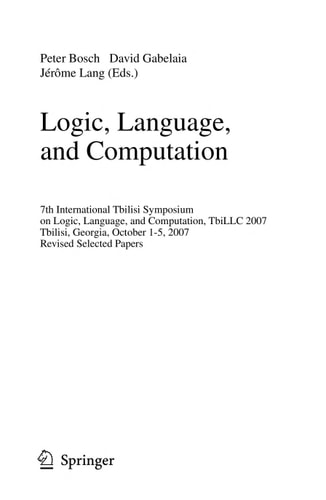
Logic, Language, and Computation: 7th International Tbilisi Symposium on Logic, Language, and Computation, TbiLLC 2007, Tbilisi, Georgia, October 1-5, 2007, Revised Selected Papers
0
0
As an Amazon Associate and affiliate partner, Menrva Books earns from qualifying purchases. Learn more
Author Description
Edited in collaboration with FoLLI, the Association of Logic, Language and Information, this book constitutes the refereed proceedings of the 7th International Tbilisi Symposium on Logic, Language, and Computation, TbiLLC 2007, held in Tbilisi, Georgia, in October 2007. The 22 revised full papers included in the book were carefully reviewed and selected from numerous presentations given at the symposium. The focus of the papers is on the following topics: conceptual modeling of spatial relations, pragmatics and game theory, atypical valency phenomena, lexical typology, formal semantics and experimental evidence, exceptional quantifier scope, Georgian focussing particles, polarity and pragmatics, dynamics of belief, learning theory, inquisitive semantics, modal logic, coalgebras, computational linguistics of Georgian, type-logical grammar and cross-serial dependencies, non-monotonic logic, Japanese quantifiers, intuitionistic logic, semantics of negated nominals, word sense disambiguation, semantics of question-embedding predicates, and reciprocals and computational complexity.
Menrva's Summary
THE THESIS
This volume investigates the intersection of logic, language, and computation through a collection of rigorously reviewed papers from the 7th International Tbilisi Symposium. The proceedings cover a wide array of topics, including conceptual modeling of spatial relations, pragmatics and game theory, lexical typology, formal semantics with experimental evidence, and the computational linguistics of Georgian. The papers explore formal logic, learning theory, and grammatical structures, offering insights into the complexities of human language and its formal representation.
THE SCOPE MAP
- Conceptual modeling of spatial relations
- Pragmatics and game theory
- Atypical valency phenomena and lexical typology
- Formal semantics and experimental evidence
- Exceptional quantifier scope and Georgian focussing particles
- Polarity and pragmatics, dynamics of belief, and learning theory
- Inquisitive semantics, modal logic, coalgebras, and computational linguistics of Georgian
- Type-logical grammar, cross-serial dependencies, non-monotonic logic, and Japanese quantifiers
- Intuitionistic logic, semantics of negated nominals, word sense disambiguation, semantics of question-embedding predicates, and reciprocals and computational complexity
THE AUTHORITY PERSPECTIVE
The papers presented at TbiLLC 2007, as reflected in these revised proceedings, cover a broad spectrum of advanced research at the confluence of logic, language, and computation. The selection process, involving careful review and selection from numerous presentations, suggests a high standard for the included contributions. The diverse topics indicate a focus on both theoretical advancements and specific linguistic phenomena, particularly those related to the Georgian language. This collection is likely to be of significant interest to researchers and advanced students in formal linguistics, theoretical computer science, and philosophical logic.
Page Count:
287
Publication Date:
2009-03-27
Publisher:
Springer Science & Business Media
ISBN-10:
3642006647
ISBN-13:
9783642006647
Science & Technology
Non-Fiction
Linguistics
Computational linguistics
Computer Science
Logic
Community Tags
Similar Books