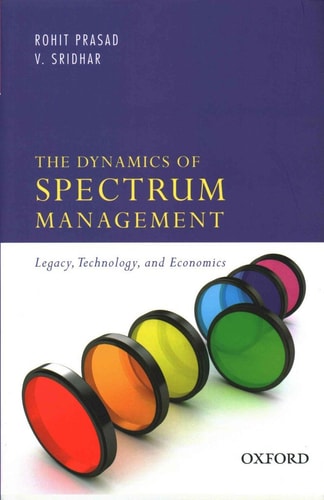
The Dynamics of Spectrum Management: Legacy, Technology, and Economics
0
0
As an Amazon Associate and affiliate partner, Menrva Books earns from qualifying purchases. Learn more
Author Description
Even as spectrum management regimes are moving from a command and control regime to a flexible use regime, new technological developments are suggesting that there are significant opportunities in managing large swathes of spectrum as a common property resource, in addition to flexible use. The demand for spectrum has never been so acute as today's communication services extend beyond simple voice to complex data and video, augmented by evolving technologies such as peer-to-peer sharing, social networking, Fourth and Fifth Generation networks, Big Data, and cloud computing. On the other hand, supply of spectrum is restricted due to competing nature of uses and vested interests of incumbent holders.Political legacies and market realities in different regimes pose unique challenges for spectrum managers who must negotiate a tricky path to the land promised by technological possibility. With case studies from early adopters of mobile technology and an in-depth exploration of the Indian case, this book presents a pragmatic and modern approach for spectrum managers to get from where they are to where they can be.This book covers the theoretical framework governing technology, and economics of spectrum. Examples derived from practices around the world are given to illustrate the underlying principles. Future technologies that enable use of spectrum spaces that have so far not been used are documented along with accompanying economic rationale and policy prescriptions. The significant addition in this book is the illustration of the migration from the command and control regime of spectrum allocation to flexible methods and further towards the spectrum of the commons. The regulatory and policy implications are discussed, drawing parallels to practices around the world. The second part of the book is devoted to the spectrum management and policies in India, starting from the initial allocation in 1995 to the substantial controversies surrounding the first-come, first serve
Menrva's Summary
THE THESIS
This book investigates the complex transition of spectrum management from rigid command-and-control models to flexible, market-oriented, and common-property frameworks. Authors Rohit Prasad and Varadharajan Sridhar utilize their expertise in telecommunications policy and economics to analyze how technological advancements in data and cloud computing collide with entrenched political legacies. By contrasting global regulatory practices with the specific evolution of the Indian telecommunications sector, the authors provide a structured framework for navigating the competing interests of incumbent holders and the necessity of efficient spectrum allocation.
THE SCOPE MAP
What You Will Find
- Theoretical frameworks governing the intersection of spectrum technology and economic policy.
- Comparative analysis of global spectrum management regimes and their migration toward flexible use.
- Detailed case studies focusing on the history and controversy of mobile technology allocation in India.
- Policy prescriptions for managing spectrum as a common property resource alongside traditional licensing.
THE AUTHORITY PERSPECTIVE
Experts identify this work as a comprehensive resource for understanding the regulatory hurdles inherent in modern telecommunications. Readers frequently note the technical and academic density of the prose, which serves as a foundational text for policymakers and students of infrastructure economics.
Page Count:
326
Publication Date:
2014-08-26
Publisher:
Oxford University Press
ISBN-10:
0198099789
ISBN-13:
9780198099789
Economics
Business
Telecommunications
Technology
Public Policy
Community Tags
Similar Books








Reader Comments
Share Your Thoughts
No comments yet. Be the first to share your thoughts!