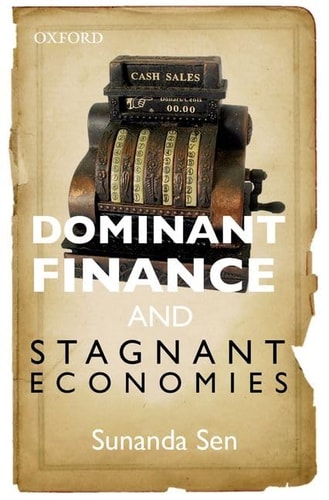
Dominant Finance and Stagnant Economies
0
0
As an Amazon Associate and affiliate partner, Menrva Books earns from qualifying purchases. Learn more
Author Description
Financialization in the world economy has led to massive accumulation as well as concentration of financial assets providing sources of rentier income which has been much higher than those obtainable from physical assets. The present volume attempts to analyse the pattern of financial dominance in the world economy with its links to the systemic crisis. The analysis rests on the theoretical perspectives underlying the Keynesian and the Minskian theoretical framework. This makes the present study of global finance offer a critique of the mainstream neo-liberal doctrine and policies.The volume consists of a collection of essays, some of which were previously published in journals and edited volumes, and a number of recent papers which are as yet unpublished. These cover a gamut of themes ranging from the paradoxes of loan tying as well as an imminent realisation in lender countries, uncertainty and speculation in commodity markets, the recent global crisis, entry and rise of China in global finance, macro-economic constraints faced by emerging economies like India and China in following a path of autonomous economic policy and inclinations on part of corporates to invest in the high-risk high-return financial assets rather than in assets which generate real activity, output and employment.The book also dwells on the hegemonic order of the international financial institutions with their iniquitous as well as destabilizing role in the world economy. Spanning the themes as above, the book very successfully demolishes the mainstream 'efficient market' doctrine and its failure in terms of policies, in the advanced as well as in the developing economies.
Menrva's Summary
THE THESIS
This volume investigates the systemic relationship between financialization, the concentration of financial assets, and the resulting stagnation of real economic activity in the global market. Sunanda Sen, a noted economist, utilizes Keynesian and Minskian theoretical frameworks to challenge the prevailing neo-liberal doctrine. By examining the shift toward rentier income and the destabilizing influence of international financial institutions, the author argues that current market policies fail to support sustainable output and employment in both advanced and emerging economies.
THE SCOPE MAP
What You Will Find
- Analysis of the shift from physical asset investment to high-risk financial speculation.
- Evaluation of the role of international financial institutions in maintaining a hegemonic and destabilizing economic order.
- Case studies on the macro-economic constraints faced by emerging economies, specifically India and China.
- Critique of the efficient market hypothesis through the lens of recent global financial crises and commodity market volatility.
THE AUTHORITY PERSPECTIVE
Experts recognize this collection as a rigorous critique of contemporary financial orthodoxy, particularly for its application of heterodox economic theory to modern global crises. Readers frequently note the academic density of the prose, which serves as a substantial resource for scholars and students of political economy.
Page Count:
368
Publication Date:
2014-02-26
Publisher:
Oxford University Press
ISBN-10:
0198095414
ISBN-13:
9780198095415
Economics
Macroeconomics
Finance
Global Economy
Community Tags
Similar Books