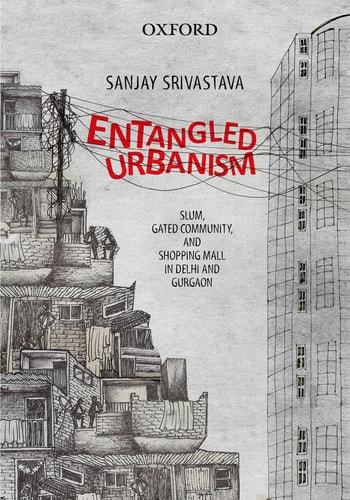
Entangled Urbanism: Slum, Gated Community and Shopping Mall in Delhi and Gurgaon
0
0
As an Amazon Associate and affiliate partner, Menrva Books earns from qualifying purchases. Learn more
Author Description
What makes a city? Rather than a totality, a city is best understood through focusing upon different but interconnected spaces and processes that make for both dynamism and instability in human lives. Hence, the book ranges across a number of sites in order to explore their connections. How do the pleasures of the gated residential enclave encompass the pain of the demolished slum locality? How do localized rituals of suburban life incorporate the symbolic procedures of the nation-state? What processes link contemporary manifestations of consumerism, the middle-classes, and the urban poor? What kind of a city is produced by the relationship between "illegal" settlements such as "slums," the traffic in fake documents that seek to stave of slum-demolitions and representatives of the "legal" city such as Residents Welfare Associations (RWAs)? What can the increasing visibility of RWAs in the quotidian politics of the city tell us about new notions of citizenship and the emergent relationships between middle-classes, the state, and the market? And, what is shared between new forms of urban religiosity, the desire for a "global" city and new consumer cultures? Through these key themes, the book examines the city as a series of overlapping meanings rather than as identifiable urban essence.
Menrva's Summary
THE THESIS
This book investigates how the disparate spaces of slums, gated communities, and shopping malls in Delhi and Gurgaon function as interconnected sites that define the modern urban experience. Sanjay Srivastava, a professor of sociology, utilizes ethnographic research and urban theory to argue that the city is not a singular entity but a collection of overlapping, often contradictory, social and political processes. He examines the friction between the middle-class desire for globalized consumption and the precarious existence of the urban poor, mapping the power dynamics that link these groups through the state and the market.
THE SCOPE MAP
What You Will Find
- Analysis of the socio-political relationship between Residents Welfare Associations and informal settlements.
- Examination of how consumer culture and shopping malls shape new definitions of citizenship.
- Ethnographic case studies focusing on the urban geography of Delhi and Gurgaon.
- Exploration of the symbolic role of the nation-state in local suburban rituals and urban planning.
THE AUTHORITY PERSPECTIVE
Scholars in the field of urban anthropology frequently cite this work for its nuanced approach to the complexities of Indian urbanization. Readers often note the academic density of the prose, which provides a rigorous framework for understanding the intersection of class, space, and governance.
Page Count:
368
Publication Date:
2014-07-29
Publisher:
Oxford University Press
ISBN-10:
0198099142
ISBN-13:
9780198099147
Sociology
Urban Studies
Anthropology
India
Cities And Towns
Community Tags
Similar Books