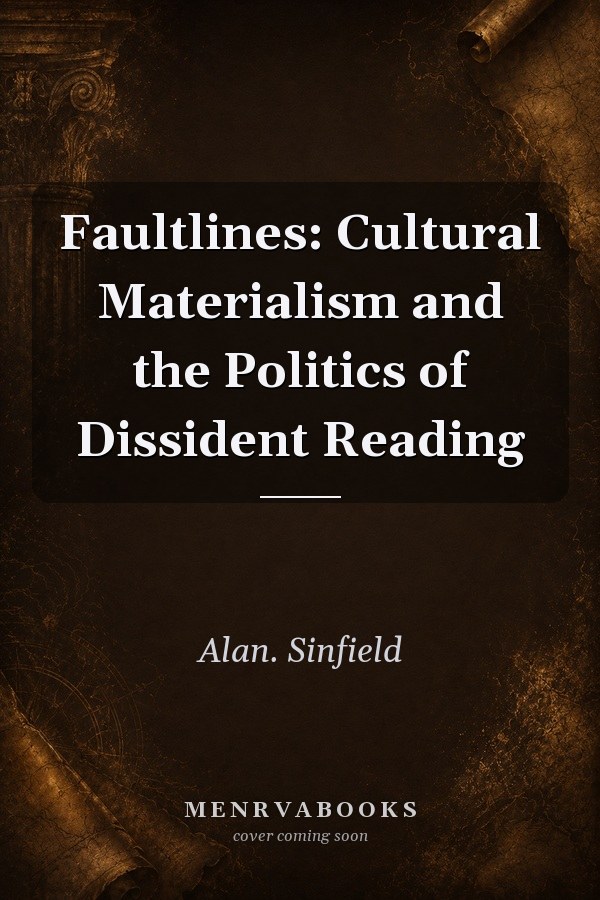
Faultlines: Cultural Materialism and the Politics of Dissident Reading
0
0
As an Amazon Associate and affiliate partner, Menrva Books earns from qualifying purchases. Learn more
Author Description
If we come to consciousness within a language that is complicit with the social order, how can we conceive, let alone organize, resistance? This key question in the politics of reading and sub cultural practice informs Alan Sin field's book on writing in early-modern England. New historicism has often shown people trapped in a web of language and culture; through agile and well informed discussions of writing by Shakespeare, Sidney, Donne, and Marlowe, Sinfield reassesses the scope of dissidence and control. The early-modern state, Christianity, and the cultural apparatus, despite an ideology of unity and explicit violence, could not but allow space to challenging voices. Disruptions in concepts of hierarchy, nationality, gender and sexuality force their way into literary texts. Sinfield is often provocative. He 'rewrites' Julius Caesar to produce a different politics, compares Sidney's idea of poetry to Leonid Brezhnev's, and reinstates the concept of character in the face of post-structuralist theory. He keeps the current politics of literary study always in view, especially in a substantial chapter on Shakespeare in the United States. Sin field subjects interactions between class, ethnicity, sexuality and the professional structures of the humanities to a detailed and hard-hitting critique, and argues for new commitments to collectivities and subcultures. This is a controversial, lucid, informed, and timely book by a leading exponent of cultural materialism.
Menrva's Summary
THE THESIS
This book investigates how dissident voices and resistance can emerge within a language and social order that is inherently complicit with established power structures. Alan Sinfield, a prominent scholar of cultural materialism, utilizes his expertise in early-modern literature to challenge the deterministic view that individuals are entirely trapped by the cultural apparatus of their time. By examining the works of Shakespeare, Sidney, Donne, and Marlowe, he argues that the early-modern state and its ideological systems were never monolithic, but rather contained inherent spaces for contradiction and subversion.
THE SCOPE MAP
What You Will Find
- Analysis of early-modern English literature including works by Shakespeare, Sidney, Donne, and Marlowe.
- A critique of the professional structures of the humanities and the politics of literary study in the United States.
- Theoretical frameworks blending cultural materialism, post-structuralism, and political theory.
- Examination of how concepts of hierarchy, nationality, gender, and sexuality disrupt dominant ideologies.
THE AUTHORITY PERSPECTIVE
Critics and scholars recognize this work as a significant contribution to cultural materialism that remains deeply engaged with contemporary political issues. Readers frequently note the intellectual rigor of Sinfield's arguments, which often challenge conventional academic interpretations of canonical texts.
Page Count:
378
Publication Date:
1992-01-01
Publisher:
University of California Press.
ISBN-10:
0198119836
ISBN-13:
9780198119838
Politics
History
British & Irish
Literary Criticism