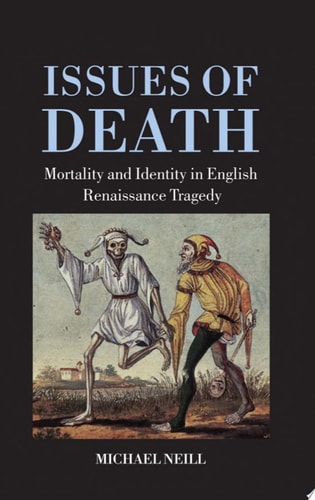
Issues of Death: Mortality and Identity in English Renaissance Tragedy
0
0
As an Amazon Associate and affiliate partner, Menrva Books earns from qualifying purchases. Learn more
Author Description
Death, like most experiences that we think of as 'natural', is a product of the human imagination: all animals die, but only human beings suffer Death; and what they suffer is shaped by their own time and culture. Tragedy was one of the principal instruments through which the culture of early modern England imagined the encounter with mortality. The essays in this book approach the theatrical reinvention of Death from three perspectives. Those in Part 1 explore Death as a trope of apocalypse - a moment of un-veiling or dis-covery that is figured both in the fearful nakedness of the Danse Macabre and in the shameful 'openings' enacted in the new theatres of anatomy. Separate chapters explore the apocalyptic design of two of the period's most powerful tragedies - Shakespeare's Othello, and Middleton and Rowley's The Changeling. In Part 2, Neill explores the psychological and affective consequences of tragedy's fiercely end-driven narrative in a number of plays where a longing for narrative closure is pitched against a particularly intense dread of ending. The imposition of an end is often figured as an act of writerly violence, committed by the author or his dramatic surrogate. Extensive attention is paid to Hamlet as an extreme example of the structural consequences of such anxiety. The function of revenge tragedy as a response to the radical displacement of the dead by the Protestant abolition of purgatory - one of the most painful aspects of the early modern re-imagining of death - is also illustrated with particular clarity. Finally, Part 3 focuses on the way tragedy articulates its challenge to the undifferentiating power of death through conventions and motifs borrowed from the funereal arts. It offers detailed analyses of three plays - Shakespeare's Anthony and Cleopatra, Webster's The Duchess of Malfi, and Ford's The Broken Heart. Here, funeral is rewritten as triumph, and death becomes the chosen instrument of an heroic self-fashioning designed to dress the
Menrva's Summary
THE THESIS
This work investigates how English Renaissance tragedy functioned as a primary cultural instrument for imagining and processing human mortality. Michael Neill, a scholar of early modern drama, utilizes a historical and psychological framework to analyze how theatrical representations of death were shaped by the specific cultural anxieties and religious shifts of the period. By examining the intersection of narrative structure and the concept of the end, the author argues that tragedy served as a site for negotiating identity in the face of inevitable extinction.
THE SCOPE MAP
What You Will Find
- Analysis of the Danse Macabre and anatomical theater as tropes of apocalypse.
- Examination of the psychological impact of narrative closure in revenge tragedies.
- Studies on the Protestant abolition of purgatory and its effect on dramatic representations of the dead.
- Detailed readings of Shakespeare, Middleton, Rowley, Webster, and Ford.
Scope Limits
- The text focuses specifically on English Renaissance tragedy and does not extend to broader European theatrical traditions.
- It does not provide a comprehensive history of funeral rites, focusing instead on their literary and dramatic adaptation.
THE AUTHORITY PERSPECTIVE
Scholars frequently cite this text as a sophisticated contribution to the study of early modern drama and cultural history. Experts note the academic density of the prose, which provides a rigorous examination of the relationship between theatrical form and the human experience of mortality.
Page Count:
424
Publication Date:
1997-01-01
Publisher:
Clarendon Press
ISBN-10:
0191588563
ISBN-13:
9780191588563
History
Drama
Categories
Dramas & Plays
British & Irish
Kindle eBooks
Death Studies
Kindle Store
In literature
Shakespeare
Tragedy
English Renaissance
Literary Criticism
Community Tags
Similar Books