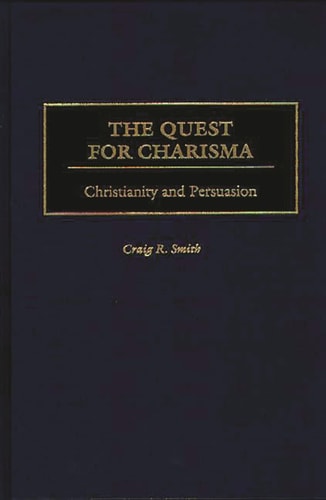
The Quest for Charisma: Christianity and Persuasion
0
0
As an Amazon Associate and affiliate partner, Menrva Books earns from qualifying purchases. Learn more
Author Description
Smith examines the major canons of classical rhetorical theory by demonstrating their influence on Christian speakers. He begins by explaining why charisma has become a misused term. He then explores why writing about charisma has been so difficult in terms of the academic prejudice in favor of objectivity and reason. He then constructs a three-level definition of charisma to replace the current one. After analyzing the charisma of Jesus in terms of the three personae he developed as teacher, human, and messiah, Smith argues that his power arose from this rich development of character. The textual charisma of the Gospel narrators is explored in terms of their narrative techniques, and Smith then examines the concept of ethos, the use of emotion in persuasion, and explicates the theories of leading existential thinkers to develop advanced notions of human responsibility and transcendent spirituality. These two notions are used to refine and improve previous definitions of charisma. Smith then establishes a matrix that crosses levels of charisma with different types of identification. This work will be of particular interest to scholars, students, and researchers involved with Christianity, philosophy, and persuasion.
Menrva's Summary
THE THESIS
This book investigates the concept of charisma within Christian discourse and its relationship to persuasion. Craig R. Smith, Ph.D., begins by dissecting the common misuse of the term 'charisma' and the academic challenges in discussing it due to a bias towards objectivity. He proposes a novel three-level definition of charisma, applying it to Jesus's persona as teacher, human, and messiah, arguing his influence stemmed from this multifaceted character development. The work further analyzes the narrative techniques of Gospel writers and explores concepts like ethos and emotional appeals in persuasion, integrating existentialist thought on human responsibility and spirituality to refine the definition of charisma.
THE SCOPE MAP
- Analysis of major canons of classical rhetorical theory and their influence on Christian speakers.
- Explanation of why 'charisma' is often misused and the academic difficulties in its study.
- Construction of a three-level definition of charisma.
- Application of the charisma definition to Jesus's personae (teacher, human, messiah).
- Examination of the textual charisma of Gospel narrators through narrative techniques.
- Exploration of ethos, the use of emotion in persuasion, and existentialist theories.
- Development of advanced notions of human responsibility and transcendent spirituality.
- Establishment of a matrix crossing levels of charisma with different types of identification.
THE AUTHORITY PERSPECTIVE
This work is positioned as a valuable resource for scholars, students, and researchers interested in the intersections of Christianity, philosophy, and persuasion. The detailed analysis of rhetorical theory and its application to Christian figures suggests a text aimed at an academic audience. By constructing a new definition of charisma and applying it to foundational religious texts and figures, the book offers a unique framework for understanding persuasive communication within a religious context. The integration of classical rhetoric with existentialist philosophy indicates a sophisticated approach to the subject matter.
Page Count:
211
Publication Date:
2000-03-30
Publisher:
Bloomsbury Academic
ISBN-10:
0275968367
ISBN-13:
9780275968366
Non-Fiction
Philosophy
Religion
Christianity
Persuasion
Rhetoric
Community Tags
Similar Books