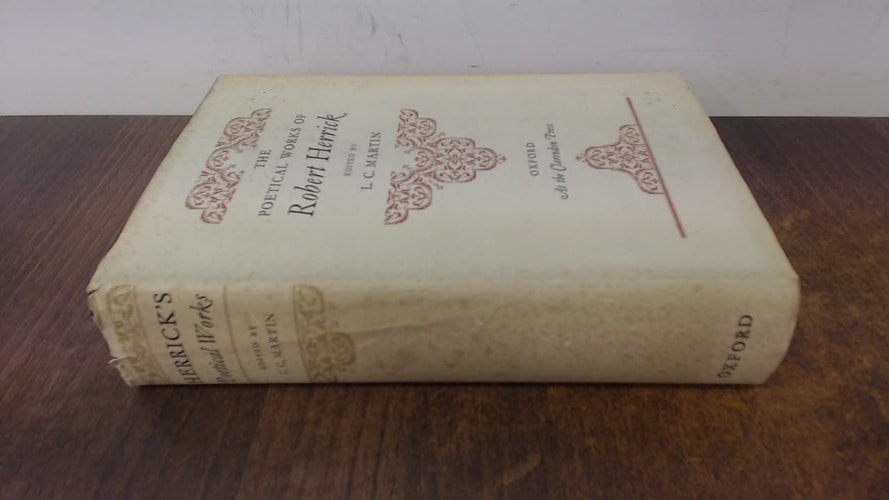
The Poetical Works of Robert Herrick
0
0
As an Amazon Associate and affiliate partner, Menrva Books earns from qualifying purchases. Learn more
Author Description
This work has been selected by scholars as being culturally important, and is part of the knowledge base of civilization as we know it. This work was reproduced from the original artifact, and remains as true to the original work as possible. Therefore, you will see the original copyright references, library stamps (as most of these works have been housed in our most important libraries around the world), and other notations in the work. This work is in the public domain in the United States of America, and possibly other nations. Within the United States, you may freely copy and distribute this work, as no entity (individual or corporate) has a copyright on the body of the work. As a reproduction of a historical artifact, this work may contain missing or blurred pages, poor pictures, errant marks, etc. Scholars believe, and we concur, that this work is important enough to be preserved, reproduced, and made generally available to the public. We appreciate your support of the preservation process, and thank you for being an important part of keeping this knowledge alive and relevant.
Menrva's Summary
THE PULSE
The central conflict involves the tension between the fleeting nature of human existence and the desire to capture beauty through structured verse. Robert Herrick, a 17th-century clergyman and poet, navigates the constraints of the Cavalier tradition, balancing pastoral idealism with the stark realities of mortality. His work functions as a collection of lyrical observations, often employing a first-person perspective to address themes of love, religious devotion, and the passage of time. The narrative framework is non-linear, organized by thematic clusters rather than a singular plot, reflecting the varied experiences of life in the English countryside.
INSIDE THE PAGES
- Frequent use of the carpe diem motif to emphasize the urgency of living.
- Incorporation of pastoral imagery depicting rural English life and nature.
- Employment of precise, rhythmic meter and traditional stanza forms.
- Exploration of religious piety contrasted with secular, sensual desires.
- Inclusion of epigrams and short, witty observations on social manners.
- Focus on the transient beauty of flowers, seasons, and human youth.
- Use of classical allusions to ground the poems in historical tradition.
- Reflections on the poet's own isolation and his relationship with his community.
THE COLLECTIVE ECHO
Readers and critics frequently highlight the technical precision and musicality of Herrick's verse. Discussion often centers on the poet's ability to elevate mundane subjects into profound meditations on the brevity of life. Scholars emphasize the importance of his work in defining the Cavalier poetic style, noting the balance between lighthearted wit and somber reflection. The collection remains a primary reference for those interested in the evolution of English lyric poetry during the mid-17th century.
Page Count:
670
Publication Date:
1956-01-01
Publisher:
Oxford at the Clarendon Press
ISBN-10:
0198118139
ISBN-13:
9780198118138
Poetry
British literature
17th Century
Classical
Anthology
Community Tags
Similar Books