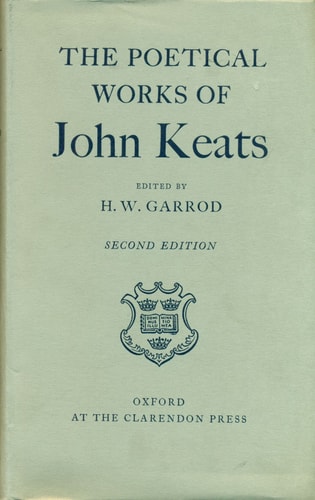
Poetical Works of John Keats
0
0
As an Amazon Associate and affiliate partner, Menrva Books earns from qualifying purchases. Learn more
Author Description
John Keats was born (prematurely) on October 29th, or 31st, 1795, at his fathers livery stable, The Swan and Hoop, Finsbury Pavement. His father was Thomas Keats, head ostler to Mr. John Jennings, owner of the stables. Thomas Keats was a West-country man, who married Miss Jennings, the daughter of his employer, and John Keats was their eldest child. The father was killed by a fall from his horse, in 1804, leaving children, John, George, Tom, and Frances Mary. A year fater, Mrs. Keats married William Rawlings, stable-keeper, from whom she was soon separated, making her home with her widowed mother, Mrs. Jennings, at Edmonton. Though he was not born in distinguished place, Keats syouth did not suffer from lack of money. Mr. Jennings, his maternal grandfather, left over 13,000:he bequeathed to his widow capital yielding 200 a year, J50 a year to Keats smother, with reversion to her children by Thomas Keats, and 1,000 to be separately held in trust for the said children, and divided among them on coming of age. TJ nhappily, during Keats slifetime, certain funds to which he was entitled were overlooked by, or unknown to, him and his advisers. Keats, between 1806 and 1810, went to the school kept by Mr. Clarke, father of Charles Cowden Clarke, at Enfield, then a rural district. As a boy he was handsome, gay, pugnacious, but the death of his consumptive mother, in 1810, caused him a long agony of grief. Keats left school in the same year. His last years had been very industrious. He rendered the whole of the A ineid into English prose. Books of mythology were his delight, and he could divine the poetry of Greece in the prose of Lempriere. That a Greek dunce, to use the name given to Scott when a boy, would persist in writing on Greek subjects, was the frequent taunt of Keats scollege-bred critics. What education did not give, Nature supplied by congruity of genius
Menrva's Summary
THE PULSE
The central conflict involves the tension between the ephemeral nature of human existence and the enduring, transformative power of beauty and art. Keats navigates the constraints of a world defined by mortality, illness, and social upheaval, seeking to capture the sublime through language. His objective is to reconcile the intensity of sensory experience with the intellectual demands of poetic form. The narrative framework is primarily lyrical, utilizing complex imagery and classical allusions to explore the human condition.
INSIDE THE PAGES
- Extensive use of classical mythology and Hellenistic themes
- Exploration of negative capability as a philosophical framework
- Rich, sensory-laden descriptions of nature and the seasons
- Introspective examinations of mortality and the passage of time
- Mastery of the sonnet, ode, and narrative verse forms
- Frequent employment of synesthesia to evoke emotional responses
- Focus on the tension between the ideal and the material world
- Rhythmic experimentation that influenced later Victorian poets
THE COLLECTIVE ECHO
Readers and critics frequently highlight the technical precision and emotional depth present in these verses. Discussion often centers on the poet's ability to render abstract philosophical concepts into tangible, vivid imagery. Scholars emphasize the influence of the Romantic movement on the structural choices made throughout the collection. The balance between the poet's youthful exuberance and his preoccupation with death remains a primary subject of academic analysis. Many readers find the atmospheric quality of the work to be the defining characteristic of the collection.
Page Count:
672
Publication Date:
1958-01-01
Publisher:
Oxford Univ Pr
ISBN-10:
0198118155
ISBN-13:
9780198118152
Poetry
Classic Literature
British literature
Romanticism
Community Tags
Similar Books