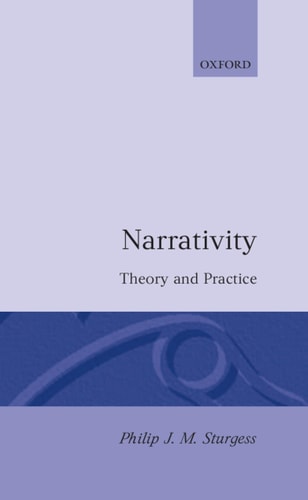
Narrativity: Theory and Practice
0
0
As an Amazon Associate and affiliate partner, Menrva Books earns from qualifying purchases. Learn more
Author Description
Defining narrativity as the enabling force of narrative, this is the first full-length exploration of the concept in fiction in English. It develops the notion of a "logic of narrativity", and by this means tries to contribute a new critical strategy to the field of narrative theory. The book also takes issue with a number of critical approaches that have in recent years acquired near-orthodox status in the matter of textual interpretation. Most prominent among these approaches are deconstruction and a particular form of Marxist criticism. The author's own theoretical claims are substantiated by readings of major twentieth-century novels by Conrad, Joyce, Flann O'Brien, and Arthur Koestler, and the book concludes with an analysis of an earlier narrative, Maria Edgeworth's Castle Rackrent, which illustrates the wider premises of the theory and its applications.
Menrva's Summary
THE THESIS
This book investigates the concept of narrativity as the fundamental enabling force of narrative, proposing a new critical framework for textual interpretation. Philip J. M. Sturgess, an academic in the field of literary studies, challenges established critical orthodoxies, specifically deconstruction and certain Marxist approaches. He argues for a 'logic of narrativity' that provides a more robust strategy for understanding how fiction functions as a coherent system of meaning.
THE SCOPE MAP
What You Will Find
- A theoretical framework defining the logic of narrativity.
- Critical analysis of twentieth-century novels by Conrad, Joyce, Flann O'Brien, and Arthur Koestler.
- A comparative study of Maria Edgeworth's Castle Rackrent to demonstrate historical application.
- A critique of contemporary critical orthodoxies including deconstruction and Marxist literary theory.
THE AUTHORITY PERSPECTIVE
Scholars and students of narrative theory recognize this work as a significant contribution to the formal study of how stories are constructed. Readers frequently note the academic density of the prose, which is intended for those already familiar with advanced literary theory and critical discourse.
Page Count:
336
Publication Date:
1992-10-22
Publisher:
Clarendon Press
ISBN-10:
0198119542
ISBN-13:
9780198119548
English fiction
Fiction
Academic
Literary theory
Narrative Theory
Literary Criticism
Community Tags
Similar Books