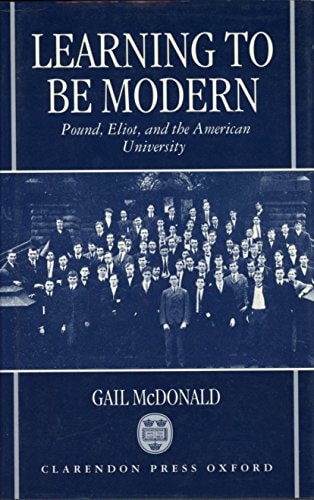
Learning to be Modern: Pound, Eliot, and the American University
0
0
As an Amazon Associate and affiliate partner, Menrva Books earns from qualifying purchases. Learn more
Author Description
It is axiomatic that the poetry of high modernism was composed by the educated for the educated. Learning to be Modern explores American educational history as a context of this commonplace: what Ezra Pound and T.S. Eliot learned in universities, how these poets needed universities, and how universities needed them. McDonald examines crucial unpublished essays as well as more familiar works by Pound and Eliot on educational topics. She also reveals the vast amount of time they devoted to pedagogical concerns, emulating and assisting the American academy's evolution from nineteenth-century religious college to twentieth-century research university. This process demanded a continuous calibration of the relationship between tradition and innovation which resulted in a curious doubleness within high modernist aesthetics and American educational philosophy--a doubleness which is echoed in the contradictions of poetry by Pound and Eliot. In addition to new readings of Pound and Eliot, this book presents a fresh way of thinking about high modernist literature at large and, in its examination of turn-of-the-century debates on educational progressivism, provides a historical context for current debates about the function of universities and the shape of the literary canon.
Menrva's Summary
THE THESIS
This book investigates the symbiotic relationship between the development of the American research university and the aesthetic evolution of high modernist poetry as exemplified by Ezra Pound and T.S. Eliot. Gail McDonald, an expert in literary history, utilizes archival research and unpublished essays to argue that the professionalization of the academy directly influenced the poetic output and pedagogical priorities of these two figures. By tracing the transition from the nineteenth-century religious college to the modern research institution, the author demonstrates how Pound and Eliot navigated the tension between tradition and innovation to shape the literary canon.
THE SCOPE MAP
What You Will Find
- Historical analysis of the American university system at the turn of the twentieth century.
- Examination of unpublished essays and pedagogical writings by Ezra Pound and T.S. Eliot.
- Comparative study of educational progressivism and modernist aesthetic theory.
- Contextual framework for understanding the evolution of the literary canon.
THE AUTHORITY PERSPECTIVE
Scholars recognize this work as a significant contribution to the study of modernist institutional history. Readers frequently note the academic density of the prose and the depth of the archival research presented by the author.
Page Count:
256
Publication Date:
1993-04-08
Publisher:
Oxford University Press
ISBN-10:
0198119801
ISBN-13:
9780198119807
Biography
American
Criticism history
Literary Criticism
Modernism
Community Tags
Similar Books