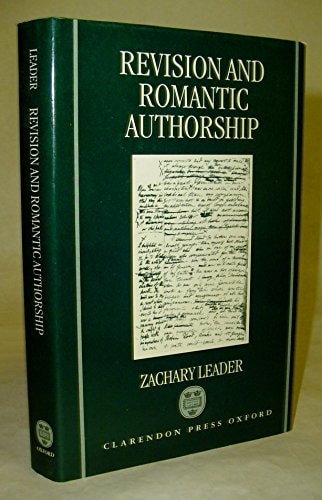
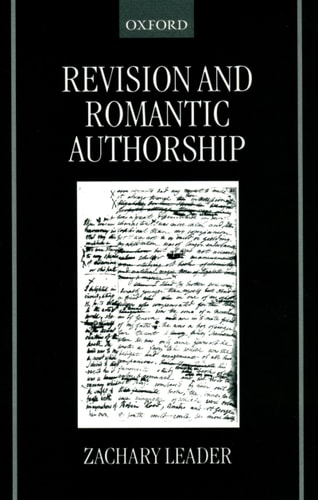
Revision and Romantic Authorship
0
0
As an Amazon Associate and affiliate partner, Menrva Books earns from qualifying purchases. Learn more
Author Description
The Romantic author as spontaneous, extemporizing, otherworldly and autonomous is a fiction much in need of revision. Zachary Leader argues that the continuing influence of a Romantic preference for what comes naturally, with a concomitant devaluing of secondary processes, distorts our understanding of the actual creative practices of writers of the period, even those most closely associated with Romantic assumptions. 'Second thoughts' (including those of collaborators) play a crucial role in the writings of Wordsworth, Byron, Coleridge, Mary Shelley, Clare, and Keats. Other assumptions complicated by a study of the actual revising practices of Romantic writers are those which associate composition with the organic and with process, or which characterize authors as independent agents or figures of coherent and consistent subjectivity. In the first part of the book, Leader shows how revisionary and editorial habits (those not only of the writers themselves but of their modern editors) reflect conflicting attitudes to the self or personal identity; in the second, these attitudes are related to the role of "collaborators" in the revising process, including family, friends, publishers, critics, and readers.
Menrva's Summary
THE THESIS
This book investigates the discrepancy between the idealized Romantic myth of spontaneous, solitary genius and the actual, often collaborative, revisionary practices of major Romantic-era writers. Zachary Leader, a scholar of English literature, challenges the long-standing critical assumption that Romantic composition was purely organic and autonomous. By examining the manuscripts and editorial histories of canonical figures, he argues that 'second thoughts' and external influences were integral to the creative process. The work provides a rigorous framework for re-evaluating authorship, personal identity, and the role of the editor in the nineteenth century.
THE SCOPE MAP
What You Will Find
- Analysis of revisionary habits in the works of Wordsworth, Byron, Coleridge, Mary Shelley, Clare, and Keats.
- Examination of the influence of collaborators, including family, friends, publishers, and critics, on the final text.
- Exploration of how modern editorial practices reflect shifting attitudes toward personal identity and the self.
- A critique of the 'organic' model of composition that has dominated Romantic studies for decades.
THE AUTHORITY PERSPECTIVE
Scholars and students of Romanticism frequently cite this text as a vital intervention in the study of textual criticism and authorial intent. Readers often note the academic density of the prose, which serves as a foundational resource for understanding the complexities of nineteenth-century literary production.
Page Count:
368
Publication Date:
1996-05-23
Publisher:
Oxford University Press
ISBN-10:
0198122640
ISBN-13:
9780198122647
History
Academic
Editing
Authorship
Romanticism
Literary Criticism
Community Tags
Other Editions(3)

Similar Books