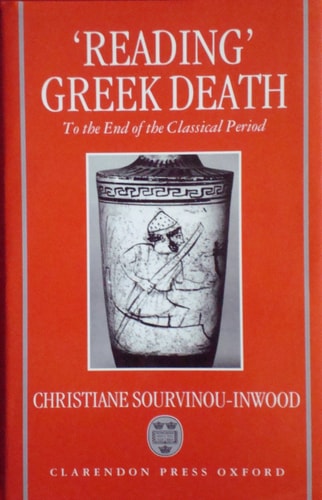
Reading Greek Death: To the End of the Classical Period
0
0
As an Amazon Associate and affiliate partner, Menrva Books earns from qualifying purchases. Learn more
Author Description
This book offers a series of in-depth studies of some aspects of the beliefs, attitudes, and rituals surrounding death in ancient Greece from the Minoan and Mycenean period to the end of the classical age. Drawing on every kind of available evidence - from literary texts to burial customs, inscriptions, and images in art - the author sheds new light on many key, still essentially problematic, aspects of Greek life, myth, and literature: including the world of the dead in Homer; the perceptions associated with grave monuments and articulated in their images and epigrams; the myths of Charon, Hermes, and the journey of death; and the shifting attitudes towards death in a changing society. The book is also a sophisticated critique of the methodologies appropriate for interpreting the various kinds of evidence for ancient beliefs, and there is discussion of these in the light of insights from anthropology and other disciplines that can help us reconstruct the ancient Greek discourse of death, while minimizing the intrusion of our own culturally determined assumptions which reflect modern thinking rather than ancient realities.
Menrva's Summary
THE THESIS
This work investigates the complex evolution of Greek attitudes, beliefs, and rituals concerning death from the Minoan period through the end of the Classical age. Christiane Sourvinou-Inwood, a noted scholar of ancient Greek religion, synthesizes diverse archaeological and literary evidence to construct a framework for understanding how the ancient Greeks conceptualized mortality. The book argues for a rigorous methodological approach that avoids projecting modern cultural biases onto ancient practices, utilizing insights from anthropology to reconstruct the authentic discourse of the period.
THE SCOPE MAP
What You Will Find
- Analysis of burial customs, funerary inscriptions, and artistic representations of death.
- Examination of the underworld and afterlife as depicted in Homeric texts.
- Methodological critique of interpreting ancient belief systems through modern lenses.
- Exploration of the myths surrounding Charon, Hermes, and the transition into death.
THE AUTHORITY PERSPECTIVE
Scholars and students of classical antiquity frequently cite this work as a foundational text for its interdisciplinary approach to funerary studies. Readers often note the academic density of the prose, which demands a high level of engagement with the provided archaeological and literary evidence.
Page Count:
502
Publication Date:
1995-04-13
Publisher:
Oxford University Press
ISBN-10:
019814976X
ISBN-13:
9780198149767
History
Social Life
Social Aspects
Ancient Greece
Criticism history
Archaeology
Anthropology
Funeral Rites
Death Studies
Community Tags
Similar Books