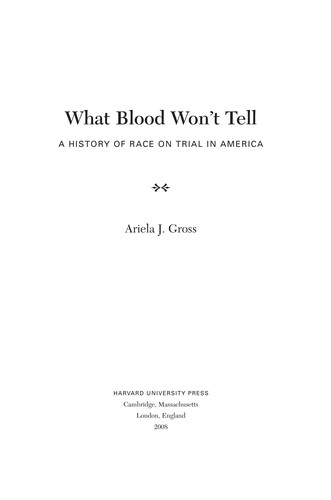
What Blood Won't Tell: A History of Race and Citizenship in America
0
0
As an Amazon Associate and affiliate partner, Menrva Books earns from qualifying purchases. Learn more
Author Description
Gross (Univ. of Southern California, School of Law) writes an amazing book that addresses the relationship between race and citizenship in the US. This book reminds us that the imaginary connection between racial identity and fitness for citizenship remains potent today and continues to impede racial justice and equality. Challenging the presumption of many scholars of the dominance of the one-drop rule in conferring black status, Gross argues that despite the rule, in court and by custom, racial boundaries were much more fluid and flexible yet, primarily in the service of white supremacy. Through a close reading of racial identity trials in America, this book offers an eloquent contribution to ongoing debates over affirmative action, identity politics and the construction of a "colorblind" society.
Menrva's Summary
THE THESIS
This book investigates the complex and often contradictory relationship between race and citizenship in the United States. Ariela J. Gross, a professor at the University of Southern California's School of Law, examines how the concept of racial identity has historically shaped and continues to influence who is considered a fit citizen. The work challenges the common understanding of the 'one-drop rule' by demonstrating that racial boundaries, particularly in legal and social contexts, were more fluid than often assumed, though primarily maintained to uphold white supremacy. Through meticulous analysis of racial identity trials, Gross contributes to critical discussions on affirmative action, identity politics, and the pursuit of a 'colorblind' society.
THE SCOPE MAP
- Analysis of racial identity trials in America to understand legal and social constructions of race.
- Exploration of the fluidity and flexibility of racial boundaries, particularly in relation to citizenship.
- Critique of the 'one-drop rule' and its impact on racial classification.
- Examination of the historical role of white supremacy in maintaining racial hierarchies.
- Contribution to ongoing debates concerning affirmative action and identity politics.
- Discussion on the construction and implications of a 'colorblind' society.
- Focus on the intersection of race, law, and citizenship in the US context.
THE AUTHORITY PERSPECTIVE
The book is recognized for its insightful examination of the historical entanglement of race and citizenship in the United States. Scholars have noted its challenge to conventional understandings of racial categorization, particularly the 'one-drop rule,' by highlighting the historical fluidity of racial boundaries. The work is considered a significant contribution to ongoing discussions about racial justice, affirmative action, and the persistent influence of racial identity on notions of belonging and equality. Its analysis of racial identity trials provides a compelling lens through which to understand the legal and social construction of race in America.
Page Count:
368
Publication Date:
2008-01-01
ISBN-10:
067403130X
ISBN-13:
9780674031302
Non-Fiction
History
Citizenship
Law
Sociology
Race Relations
Community Tags
Similar Books