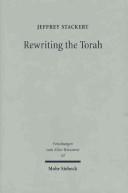
Rewriting the Torah
0
0
As an Amazon Associate and affiliate partner, Menrva Books earns from qualifying purchases. Learn more
Author Description
Jeffrey Stackert explores literary correspondences among the pentateuchal legal corpora and especially the relationships between similar laws in Deuteronomy and the Holiness Legislation (Lev 17-26, the so-called Holiness Code, as well as significant parts of the Priestly source elsewhere in the Pentateuch). Resemblances between these law collections range from broad structure to fine detail and include treatments of similar legal topics, correlations with regard to sequence of laws, and precise grammatical and lexical correspondences. Yet the nature and basis of these resemblances persist as debated points among biblical scholars. Through an analysis of the pentateuchal laws on asylum, seventh-year release, manumission, and tithes, the author argues that the Holiness Legislation depends upon both the Covenant Collection and Deuteronomy. He also elucidates the compositional logic of the Holiness legislators, showing that these authors do not simply replicate pre-existing legal content. Rather, they employ a method of literary revision in which they reconceptualize source material according to their own ideological biases. In the end, the Holiness Legislation proves to be a super law that collects and distills the Priestly and non-Priestly laws that precede it. By accommodating, reformulating, and incorporating various viewpoints from these sources, the Holiness authors create a work that is intended to supersede them all. -- ‡c From publisher's description.
Menrva's Summary
THE THESIS
This book investigates the complex literary relationships and ideological underpinnings of the legal corpora within the Pentateuch, particularly focusing on Deuteronomy and the Holiness Legislation. Jeffrey Stackert, drawing on extensive analysis of laws concerning asylum, seventh-year release, manumission, and tithes, argues that the Holiness Legislation is a sophisticated revision of earlier legal texts, including the Covenant Collection and Deuteronomy. The author demonstrates that the authors of the Holiness Code did not merely copy existing laws but actively reconceptualized them, embedding their own ideological biases into the material. Ultimately, Stackert posits that the Holiness Legislation functions as a superseding legal framework, designed to absorb, reformulate, and ultimately replace preceding legal traditions within the Priestly and non-Priestly sources.
THE SCOPE MAP
- Analysis of literary correspondences among Pentateuchal legal corpora.
- Detailed examination of relationships between laws in Deuteronomy and the Holiness Legislation (Lev 17-26).
- Comparison of broad structure, specific details, legal topics, and sequence of laws.
- Identification of precise grammatical and lexical correspondences between legal texts.
- Argument for the dependence of the Holiness Legislation on the Covenant Collection and Deuteronomy.
- Elucidation of the compositional logic and ideological biases of the Holiness legislators.
- Demonstration of a method of literary revision in which authors reconceptualize source material.
- Conclusion that the Holiness Legislation acts as a super law, collecting and distilling prior legal traditions.
THE AUTHORITY PERSPECTIVE
The scholarly reception of Stackert's work centers on its detailed textual analysis and its argument for the Holiness Legislation as a deliberate act of literary revision. Scholars acknowledge the meticulous comparison of legal corpora, noting the author's engagement with debates surrounding the nature and basis of resemblances between these texts. The book is recognized for its contribution to understanding the compositional strategies and ideological aims of the Holiness authors, who are presented not as mere compilers but as active reinterpreters of tradition. The thesis that the Holiness Legislation functions as a superseding legal document, accommodating and reformulating earlier viewpoints, is a key point of discussion within biblical scholarship.
Page Count:
273
Publication Date:
2007-01-01
ISBN-10:
3161492986
ISBN-13:
9783161492983
Non-Fiction
History
Law
Community Tags
Similar Books