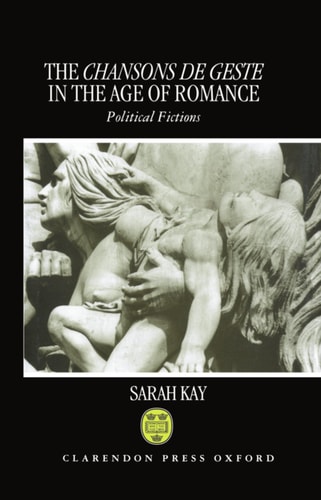
The Chansons de Geste in the Age of Romance: Political Fictions
0
0
As an Amazon Associate and affiliate partner, Menrva Books earns from qualifying purchases. Learn more
Author Description
This is a major reassessment of the relation between the medieval French chansons de geste and the romance genre. Critics have traditionally seen romance as a superior development of the chanson de geste. The chanson de geste are seen as 'formulaic', composed from a public fund of pre-existant and primarily oral narratives and motifs; romance on the other hand, is seen as a more sophisticated product of a newly 'literary' story-telling, line with the more complex social and political conditions of the time. Sarah Kay rejects this 'developmental' model of literary history and, through detailed readings of large numbers of texts - from the well-known Renaut de Montauban or Raoul de Cambrai to the unjustly neglected Doon de la Roche or Orson de Beauvais - reveals the simultaneity of the chansons de geste and romance in medieval culture. Drawing tellingly on recent literary and feminist theory, Kay argues that the chanson de geste and romance are engaged in a productive and telling dialogue.
Menrva's Summary
THE THESIS
This work investigates the historical and literary relationship between the medieval French chansons de geste and the romance genre, challenging the traditional view that romance represents a superior evolutionary stage. Sarah Kay, a scholar of medieval French literature, utilizes a framework grounded in literary and feminist theory to dismantle the developmental model of literary history. By examining the political and social contexts of the era, she argues that these two genres existed simultaneously and engaged in a complex, productive dialogue rather than a linear progression.
THE SCOPE MAP
What You Will Find
- Comparative analysis of canonical and lesser-known texts including Renaut de Montauban, Raoul de Cambrai, Doon de la Roche, and Orson de Beauvais.
- A critique of traditional literary historiography regarding oral versus literary storytelling traditions.
- Application of contemporary literary and feminist theory to medieval narrative structures.
- Examination of the political and social conditions influencing medieval French literary production.
THE AUTHORITY PERSPECTIVE
Scholars and students of medieval literature frequently cite this text as a critical intervention in the study of genre development. Experts highlight the density of the prose and the rigor of the textual analysis as essential for understanding the interplay between medieval political structures and narrative form.
Page Count:
288
Publication Date:
1996-01-25
Publisher:
Oxford University Press
ISBN-10:
0198151926
ISBN-13:
9780198151920
History
French literature
Literary Criticism
Romances
Criticism history
Community Tags
Similar Books