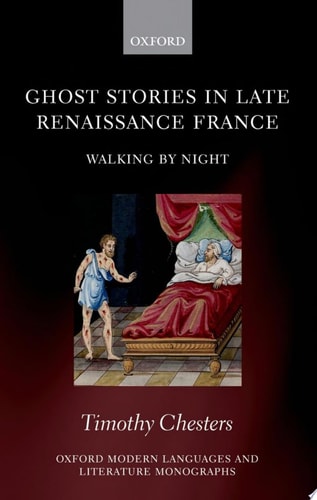
Ghost Stories in Late Renaissance France: Walking by Night
0
0
As an Amazon Associate and affiliate partner, Menrva Books earns from qualifying purchases. Learn more
Author Description
Caught in the grip of savage religious war, fear of sorcery and the devil, and a deepening crisis of epistemological uncertainty, the intellectual climate of late Renaissance France (c. 1550-1610) was one of the most haunted in European history. Although existing studies of this climate have been attentive to the extensive body of writing on witchcraft and demons, they have had little to say of its ghosts. Combining techniques of literary criticism, intellectual history, and the history of the book, this study examines a large and hitherto unexplored corpus of ghost stories in late Renaissance French writing. These are shown to have arisen in a range of contexts far broader than was previously thought: whether in Protestant polemic against the doctrine of purgatory, humanist discussions of friendship, the growing ethnographic consciousness of New World ghost beliefs, or courtroom wrangles over haunted property. Chesters describes how, over the course of this period, we also begin to see emerge characteristics recognisable from modern ghost tales: the setting of the 'haunted house', the eroticised ghost, or the embodied revenant. Taking in prominent literary figures including Rabelais, Ronsard, Montaigne, d'Aubigné, as well as forgotten demonological tracts and sensationalist pamphlets, Ghost Stories in Late Renaissance France sheds new light on the beliefs, fears, and desires of a period on the threshold of modernity. It will be of interest to any scholar or student working in the field of early modern European history, literature or thought.
Menrva's Summary
THE THESIS
This study investigates the neglected corpus of ghost stories in late Renaissance France to determine how these narratives reflect the intellectual and cultural anxieties of a society in transition. Timothy Chesters, a scholar of early modern French literature, utilizes a multidisciplinary approach that integrates literary criticism, intellectual history, and the history of the book. By analyzing a wide range of primary sources—from demonological tracts to humanist essays—he argues that ghost stories served as a critical site for negotiating religious, social, and epistemological tensions between 1550 and 1610.
THE SCOPE MAP
What You Will Find
- Analysis of ghost narratives within Protestant polemics, ethnographic reports, and legal disputes.
- Examination of literary works by Rabelais, Ronsard, Montaigne, and d'Aubigné.
- Investigation into the emergence of modern tropes such as the haunted house and the eroticized ghost.
Scope Limits
- The study is strictly confined to the French intellectual climate between 1550 and 1610.
- It does not provide an exhaustive survey of all European ghost lore, focusing specifically on the French context.
THE AUTHORITY PERSPECTIVE
Scholars recognize this work as a significant contribution to the study of early modern mentalities and the history of the supernatural. Readers frequently note the academic rigor and the breadth of the primary source material utilized by the author to bridge the gap between literature and cultural history.
Page Count:
304
Publication Date:
2011-01-01
Publisher:
Oxford University Press
ISBN-10:
0191616702
ISBN-13:
9780191616709
History
Folklore
Cultural History
English & College Success
English
Literary Criticism
Criticism history
French literature