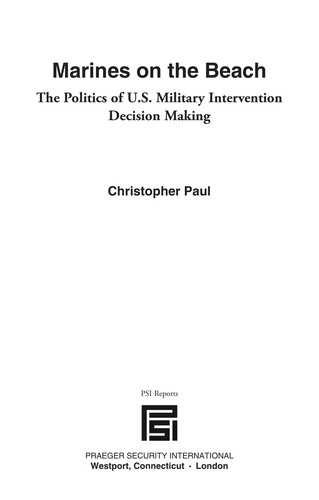
Marines on the Beach
0
0
As an Amazon Associate and affiliate partner, Menrva Books earns from qualifying purchases. Learn more
Author Description
Paul explores both how and why U.S. military intervention decisions are made. Pursuit of that inquiry requires the identification of decision participants thorough examination of the decision-making processes they employ and recognition of several factors that influence intervention decisions: the national interest, legitimacy, and the legacies of previous policies. This book provides chapter-length treatment of each of these issues. The research is based on detailed historical case studies for the four U.S. "Marines on the beach" military interventions in Latin America since World War II: The Dominican Republic (1965), Grenada (1983), Panama (1989), and Haiti (1994). Additional cases (notably Afghanistan and Iraq) enter the discussion when Paul considers findings with broader implications. Of the existing theories of governance that compete to explain government policymaking, Paul finds that elite theory provides the best general model for intervention decision-making, but that the notions of both pluralist and class theorists contribute to a complete explanation, sometimes in an unexpected way. Findings also indicate considerable contribution from and constraint by institutional sources. However, far from finding that institutional factors are wholly deterministic, this research offers support for a "choice-within-constraints" model. Conclusions suggest that top decision-makers (especially the president) enjoy wide latitude in framing the national interest and in choosing whereto and where not to intervene.--book jacket.
Menrva's Summary
THE THESIS
This book investigates the complex factors and decision-making processes behind U.S. military intervention decisions in Latin America since World War II. Christopher R. C. Paul, drawing on his expertise, examines the roles of participants, the influence of national interest, legitimacy, and past policies. The research is grounded in detailed historical case studies of interventions in the Dominican Republic (1965), Grenada (1983), Panama (1989), and Haiti (1994), with broader implications discussed through additional cases like Afghanistan and Iraq. Paul ultimately supports a "choice-within-constraints" model, suggesting significant latitude for top decision-makers in shaping intervention choices.
THE SCOPE MAP
- Analysis of U.S. military intervention decision-making processes.
- Examination of key influencing factors: national interest, legitimacy, and policy legacies.
- Detailed historical case studies: Dominican Republic (1965), Grenada (1983), Panama (1989), Haiti (1994).
- Discussion of broader implications using cases like Afghanistan and Iraq.
- Evaluation of governance theories, favoring elite theory as a primary model for intervention decisions.
- Consideration of contributions from pluralist and class theorists.
- Assessment of institutional influences and constraints on decision-making.
- Support for a "choice-within-constraints" model of intervention.
THE AUTHORITY PERSPECTIVE
This book is regarded as a thorough academic examination of U.S. foreign policy decision-making regarding military interventions. The author's detailed case studies and theoretical analysis provide a robust framework for understanding these complex choices. The research is noted for its nuanced approach, integrating various theoretical perspectives to explain intervention patterns. It offers valuable insights into the interplay of leadership, institutional factors, and geopolitical considerations in shaping foreign policy.
Page Count:
0
Publication Date:
2008-01-01
ISBN-10:
031335684X
ISBN-13:
9780313356841
Non-Fiction
Politics
History
International relations
Military History
Community Tags
Similar Books