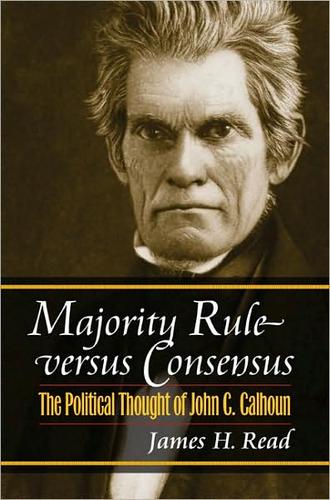
Majority Rule versus Consensus
0
0
As an Amazon Associate and affiliate partner, Menrva Books earns from qualifying purchases. Learn more
Author Description
John C. Calhoun may be best known for his stature in the U.S. Senate and his controversial defense of slavery, but he is also a key figure in American political thought. The staunchest advocate of the consensus model of government as an alternative to majority rule, he proposed government not by one, by few, or by many, but by all: each key group enjoying veto rights over collective decisions. Some consider consensus preferable to majority rule in deeply divided societies, and consensus theory has been advocated in such contemporary works as Lani Guinier's The Tyranny of the Majority. James Read's book, the first historically informed, theoretically sophisticated critique of Calhoun's political thought, goes beyond other studies to ask key questions about the feasibility of consensus. Read critically examines Calhoun's arguments, considering both their antebellum context--including Calhoun's spirited defense of slavery--and modern-day attempts to apply consensus models in Northern Ireland, the former Yugoslavia, and South Africa. Read sheds new light on the crisis leading up to the Civil War by exploring Calhoun's conviction that his uncompromising defense of slavery would help preserve the Union. He also juxtaposes Calhoun's thought with that of Jefferson and Madison, whose legacies Calhoun invoked to support his claim that states had the right to nullify federal law, and he contrasts Madison's ultimate faith in majority rule with Calhoun's ultimate rejection of it. Read argues that, although Calhoun's critique of majority rule deserves careful attention, his remedy is unworkable and in the end unjust. Read demonstrates that governments ruled by consensus tend to be ineffective, that they are better at preventing common action than achieving common goods, and that they privilege strategically placed minorities rather than producing genuine consensus. Majority Rule versus Consensus is a provocative work that sheds new light on the promise and limitations of demo
Menrva's Summary
THE THESIS
This book critically examines John C. Calhoun's political philosophy, particularly his advocacy for consensus government as an alternative to majority rule. James Read, a scholar of political thought, analyzes Calhoun's arguments within their antebellum context, including his defense of slavery, and contrasts them with modern applications of consensus models in divided societies. The work also juxtaposes Calhoun's ideas with those of Jefferson and Madison, exploring Calhoun's invocation of their legacies to support states' rights and nullification. Read ultimately argues that while Calhoun's critique of majority rule warrants attention, his proposed consensus remedy is both unworkable and unjust, leading to ineffective governance and the privileging of strategic minorities.
THE SCOPE MAP
- What You Will Find:
- A historical and theoretical critique of John C. Calhoun's political thought.
- Analysis of Calhoun's consensus model of government as an alternative to majority rule.
- Examination of the antebellum context, including Calhoun's defense of slavery.
- Comparison of Calhoun's ideas with those of Jefferson and Madison regarding states' rights and nullification.
- Case studies of modern consensus models in Northern Ireland, the former Yugoslavia, and South Africa.
- An argument for the impracticality and injustice of Calhoun's consensus remedy.
THE AUTHORITY PERSPECTIVE
The Authority Perspective: This book is recognized as the first historically informed and theoretically sophisticated critique of Calhoun's political thought regarding consensus versus majority rule. It is noted for its in-depth examination of Calhoun's arguments, placing them within their historical context and evaluating their modern-day applicability. The work is considered provocative for its analysis of the limitations and potential injustices of consensus-based governance, particularly in deeply divided societies. Read's argument that Calhoun's remedy is unworkable and unjust provides a critical perspective on a significant aspect of American political theory.
Page Count:
288
Publication Date:
2009-01-01
ISBN-10:
0700616357
ISBN-13:
9780700616350
Non-Fiction
Science
History
Philosophy
Politics
Political Theory
American Politics
Community Tags
Similar Books