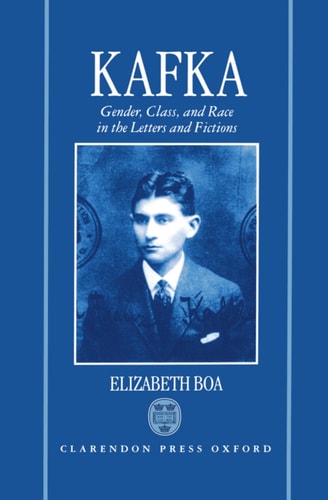
Kafka: Gender, Class, and Race in the Letters and Fictions
0
0
As an Amazon Associate and affiliate partner, Menrva Books earns from qualifying purchases. Learn more
Author Description
Boa's new study of Kafka relates gender to other facets of identity. She shows how Kafka, while exploiting such stereotypes as the New Woman, the Magna Mater, the Whore, and the assimilating Jew for literary raw material, undermined these stereotypes and rejected patriarchal attitudes of his period. Boa places Kafka's alienating images of the male body and fascinated disgust of female sexuality in context with the militaristic, racist, gender, and class ideologies of the early twentieth century. She draws on Kafka's letters to his fiancée and to the Czech journalist, Milena, to illuminate how he transformed the details of this reactionary world into the strange signs and devices which assure his place in the modernist canon.
Menrva's Summary
THE THESIS
This study investigates how Franz Kafka navigated and subverted the prevailing ideologies of gender, class, and race within his literary works and personal correspondence. Elizabeth Boa, a scholar of German literature, utilizes a critical framework that bridges Kafka's private letters to his fiancée and Milena Jesenská with his published fiction. By situating Kafka within the socio-political climate of the early twentieth century, the author argues that his work functions as a complex critique of the patriarchal, militaristic, and racist structures of his time. The text demonstrates how Kafka transformed these societal pressures into the distinct, alienating imagery that defines his modernist legacy.
THE SCOPE MAP
What You Will Find
- Analysis of gender archetypes including the New Woman, the Magna Mater, and the Whore.
- Examination of Kafka's personal correspondence as a lens for understanding his creative process.
- Contextualization of Kafka's work within early twentieth-century European class and racial ideologies.
- Discussion of the male body and female sexuality as recurring motifs in Kafka's narratives.
THE AUTHORITY PERSPECTIVE
Scholars and critics frequently cite this work as a significant contribution to the study of Kafka's intersectional themes. The text is recognized for its rigorous academic approach and its ability to provide a nuanced reading of Kafka's complex relationship with the social norms of his era.
Page Count:
320
Publication Date:
1996-06-27
Publisher:
Clarendon Press
ISBN-10:
019815819X
ISBN-13:
9780198158196
Biography
Gender Studies
Literary Criticism
Modernism
In literature
European History
Community Tags
Similar Books