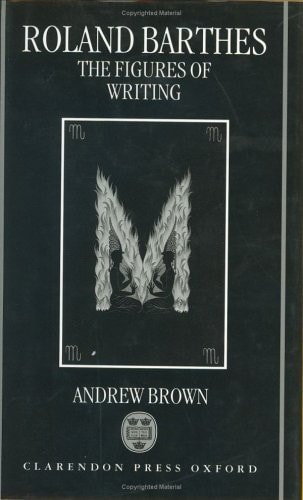
Roland Barthes: The Figures of Writing
0
0
As an Amazon Associate and affiliate partner, Menrva Books earns from qualifying purchases. Learn more
Author Description
The first serious analysis of Barthes as a writer with specific aesthetic techniques, this fresh and original study focuses on some of the ways he discusses the nature of his own writing. The first two chapters examine the key but ambiguous term of "derive" ("drift"), a word which raises questions about how exactly Barthes's writing develops across three decades, about the "scientific" legitimacy of his concepts, and about his own frequently fraught relation to the scientific discourses around him, especially psychoanalysis. Two typical discursive maneuvers that structure his writing, "naming" and "framing," are then shown to generate particular aesthetic effects which cause complications for some of his theoretical stances. Barthes's fascination for the idea that all writing is a kind of scribble, closer to the visual arts than to speech, is investigated in depth, and his latent animosity against speech as such is made manifest. The final chapter suggests that, for Barthes, "the real" can leave its mark on writing only as a disturbing, indeed traumatic trace.
Menrva's Summary
THE THESIS
This study investigates the aesthetic techniques and discursive strategies that define Roland Barthes's body of work, questioning how his writing functions as a distinct form of artistic expression. Andrew J. Leigh Brown, a scholar of critical theory, examines Barthes's evolving methodology across three decades of intellectual output. The book analyzes the tension between Barthes's theoretical concepts and his practical application of writing, specifically addressing his complex relationship with psychoanalysis and scientific discourse.
THE SCOPE MAP
What You Will Find
- Analysis of the concept of 'derive' or 'drift' in Barthes's intellectual development.
- Examination of 'naming' and 'framing' as structural maneuvers in his prose.
- Investigation into the comparison between writing and visual arts versus speech.
- Exploration of the 'traumatic trace' of reality within written texts.
THE AUTHORITY PERSPECTIVE
Scholars recognize this work as a significant contribution to the study of Barthes's stylistic evolution rather than merely his theoretical output. The text is noted for its focused approach to the mechanics of Barthes's prose, making it a valuable resource for those interested in the intersection of semiotics and literary aesthetics.
Page Count:
320
Publication Date:
1992-11-12
Publisher:
Clarendon Press
ISBN-10:
0198151713
ISBN-13:
9780198151715
Biography
Philosophy
Literature
Metaphor
Semiotics
Literary Criticism
Community Tags
Similar Books