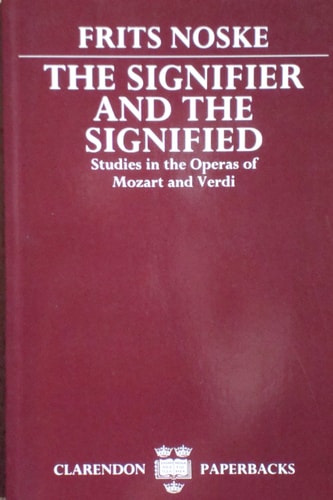
The Signifier and the Signified: Studies in the Operas of Mozart and Verdi
0
0
As an Amazon Associate and affiliate partner, Menrva Books earns from qualifying purchases. Learn more
Author Description
The studies collected here deal with the interpretation of opera, based on structural analysis. In addition to the chapters devoted to individual operas by Mozart and Verdi, the book offers studies on the semantics of orchestration in Mozart and the structural functions of ritual scenes, the musical Figure of Death, and the cabaletta in Verdi. Appendices include a discussion of semiotic devices in opera, and the complete correspondence between Verdi and Boito on the revision of Boccanegra printed with the Italian text and English translations.
Menrva's Summary
THE THESIS
This work investigates the intersection of structural analysis and musical semantics to determine how operatic conventions function as communicative devices in the works of Mozart and Verdi. Frits Noske, a distinguished musicologist, utilizes a rigorous analytical framework to examine how specific musical gestures, orchestration choices, and structural forms convey meaning within the operatic tradition. By focusing on the interplay between the signifier—the musical score—and the signified—the dramatic or emotional intent—the author provides a systematic method for interpreting complex operatic narratives.
THE SCOPE MAP
What You Will Find
- Structural analysis of selected operas by Wolfgang Amadeus Mozart and Giuseppe Verdi
- Examination of the semantics of orchestration and its role in characterization
- Investigation into the functional use of ritual scenes and the musical representation of death
- Analysis of the cabaletta form and its dramatic utility in Verdi's compositions
- Primary source documentation including the correspondence between Verdi and Boito regarding the revision of Simon Boccanegra
THE AUTHORITY PERSPECTIVE
Musicologists and scholars frequently cite this text as a foundational resource for understanding the semiotic dimensions of nineteenth-century opera. Readers often note the high level of technical density in the prose, which assumes a strong background in music theory and operatic history.
Page Count:
430
Publication Date:
1990-07-12
Publisher:
Oxford University Press
ISBN-10:
0198162014
ISBN-13:
9780198162018
Music
Opera
Musicology
Semiotics
Music theory
Community Tags
Similar Books