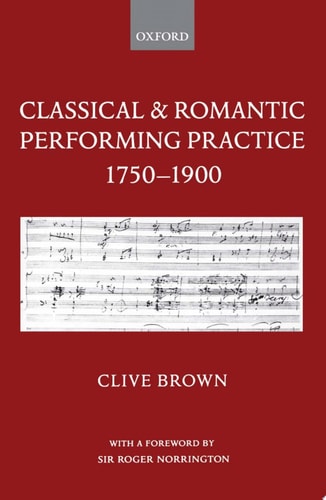
Classical and Romantic Performing Practice 1750-1900
0
0
As an Amazon Associate and affiliate partner, Menrva Books earns from qualifying purchases. Learn more
Author Description
The Past Ten Years Have Seen A Rapidly Growing Interest In Performing And Recording Classical And Romantic Music With Period Instruments; Yet The Relationship Of Composers' Notation To Performing Practices During That Period Has Received Only Sporadic Attention From Scholars, And Many Aspects Of Composers' Intentions Have Remained Uncertain. Clive Brown Here Identifies Areas In Which Musical Notation Conveyed Rather Different Messages To The Musicians For Whom It Was Written Than It Does To Modern Performers, And Seeks To Look Beyond The Notation To Understand How Composers Might Have Expected To Hear Their Music Realized In Performance. There Is Ample Evidence To Demonstrate That, In Many Respects, The Sound Worlds In Which Mozart, Beethoven, Wagner, And Brahms Created Their Music Was More Radically Different From Ours Than Is Generally Assumed. This Is An Essential Book For All Performers And Students Of Classical And Romantic Music.
Menrva's Summary
THE THESIS
This work investigates the critical disconnect between historical musical notation and the performance practices intended by composers between 1750 and 1900. Clive Brown, a scholar of historical performance, utilizes extensive primary source analysis to demonstrate that modern interpretations of notation often diverge significantly from the original intent of composers such as Mozart, Beethoven, and Brahms. The book argues that the sound worlds of the Classical and Romantic eras were fundamentally distinct from contemporary expectations, necessitating a re-evaluation of how performers approach scores from this period.
THE SCOPE MAP
What You Will Find
- Detailed analysis of notation conventions including articulation, phrasing, and ornamentation.
- Historical context regarding the evolution of period instruments and their influence on composition.
- Comparative studies of performance practices across the 18th and 19th centuries.
Scope Limits
- The text focuses primarily on Western European art music and does not cover non-Western traditions.
- It does not provide a comprehensive guide to every individual composer but focuses on broader stylistic trends and common notational ambiguities.
THE AUTHORITY PERSPECTIVE
Experts and musicologists frequently cite this work as a foundational text for understanding the nuances of historical performance practice. Readers often note the academic density of the prose, which serves as a rigorous resource for professional musicians and advanced students of musicology.
Page Count:
682
Publication Date:
1999-01-01
Publisher:
Oxford University Press, Incorporated
ISBN-10:
0191541702
ISBN-13:
9780191541704
Music
Performance Practice
Music History
Music Performance
Music theory
Musicology
Community Tags
Similar Books